
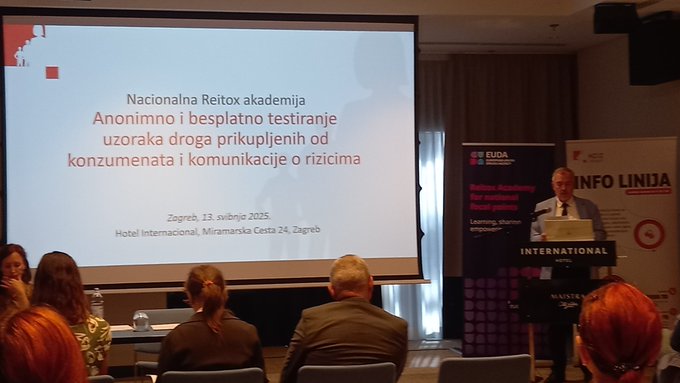
The Croatian Institute of Public Health and the European Union Drugs Agency (EUDA) organized the National Reitox Academy on Science-Based Prevention on 16 September 2024 in Zagreb. DPNSEE Executive Director Milutin Milošević participated on the invitation from the Institute.
The aim of this expert meeting was to present the principles of science-based prevention and examples of quality prevention programs implemented in other countries, and to open a discussion on models for improving national prevention interventions.
Namely, epidemiological indicators of the prevalence of substance use in recent years show an increase in the consumption of addictive substances among young people. At the same time, the National Strategy for Action in the Field of Addiction by 2030 and the accompanying Action Plan, adopted in January 2024, emphasize that preventive activities need to be implemented through an integrated, multidisciplinary and science-based approach and coherent action of all departments at the national and local levels. The aforementioned strategic documents also emphasize the need to develop, implement, sustain and improve the availability of quality, scientifically based and proven effective projects and programs for the prevention of addiction and behavioral addictions. This is precisely why the National RTX Academy was held, which represents a continuation of the HZJZ’s investment in quality – proven effective prevention.
The meeting was opened by the representative of the European Union Agency for Drugs, Mr. Gregor Burkhart, MD, and welcoming speeches were given by the representative of the Ministry of Science, Education and Youth – Ms. Marijana Gojčeta, and on behalf of the Ministry of Health and the Croatian Institute of Public Health – Assoc. Prof. Dr. Sc. Krunoslav Capak, prim. MD, spec., Director of the HZJZ. Lectures and a panel discussion were given by experts in the field of prevention from the European Union Agency for Drugs, and from Estonia, Spain, Brazil, Germany, Austria, Bosnia and Herzegovina and Croatia.
The panel discussion discussed the challenges and key factors influencing the implementation of proven effective programmes and approaches, with particular emphasis on the importance of faithful implementation, inter-institutional cooperation, the need to align prevention strategies with previously conducted needs assessments, the need to conduct short-term evaluations as well as scientific evaluation studies, strengthening the implementation of prevention strategies in the environment, and the need to harmonize prevention systems.