
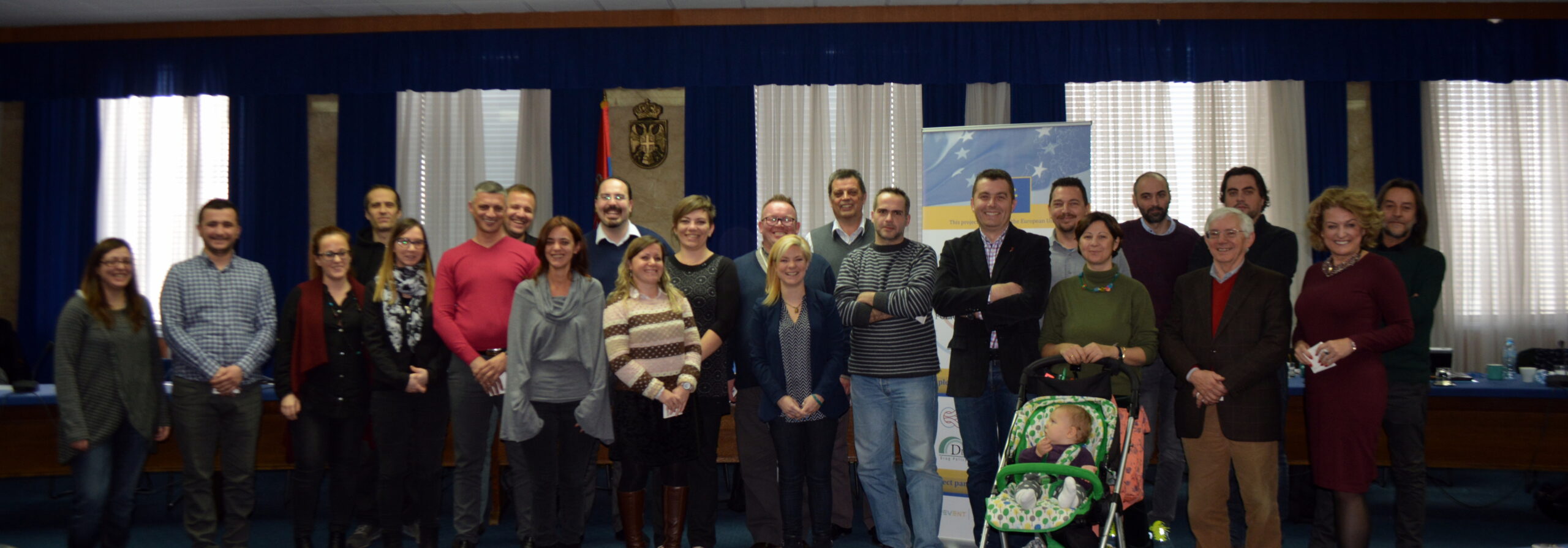
The Drug Policy Network South East Europe was formally registered at the Serbian Business Registers Agency on 15 October 2015. Over a decade, DPNSEE has expanded to include 26 member organisations from 11 countries in South East Europe, covering Albania, Bosnia and Herzegovina, Bulgaria, Croatia, North Macedonia, Greece, Kosovo*, Montenegro, Romania, Serbia and Slovenia. These members are key service providers and advocates working in prevention, harm reduction, treatment, rehabilitation and social reintegration.
Key Areas of Work
- Policy Dialogue and Advocacy
DPNSEE has established a sustained track record of facilitating government – civil society dialogues on drug policy, first convened in 2018 and repeated in 2020 and 2023 in Belgrade – creating a recognised regional platform for constructive exchange between policymakers and civil society actors. These events have strengthened mutual understanding and contributed to more inclusive policy processes.
- Public Health and Harm Reduction
The Network and its members are deeply involved in promoting harm reduction as a public health priority, including through regional research, policy analysis and advocacy. DPNSEE’s Resource Centre collects and shares a comprehensive repository of drug policy documents, including materials on harm reduction, criminal law, human rights, and service models across the SEE region.
DPNSEE also participates in UNODC-led projects supporting continuity of HIV prevention, treatment and harm reduction services among key populations – including people who use drugs and refugees from Ukraine, Russia and Belarus – with coordinated regional implementation alongside member organisations.
- Research, Knowledge Sharing and Capacity Building
DPNSEE produces policy briefings, regional assessments and position papers (e.g., on decriminalisation and service gaps) and organises webinars, workshops and training to strengthen skills and knowledge among civil society actors. It collaborates with European networks such as the Correlation – European Harm Reduction Network (C-EHRN) on joint projects like BOOST, which supports advocacy and community-led efforts to improve harm reduction services.
- International Engagement
The Network is a member of influential international bodies including the European Union’s expert group Civil Society Forum on Drugs, the International Drug Policy Consortium (IDPC) and the Vienna NGO Committee on Drugs, linking SEE civil society voices into global policy forums such as the UN Commission on Narcotic Drugs. DPNSEE is accredited by the United Nations Economic and Social Council (ECOSOC), which enables attenddance and engagement in key UN policy-making fora such as the UN General
Assembly, the UN Human Rights Council, and the UN Commission on Narcotic Drugs.
Notable Achievements (2015 – 2025)
- Institutional Establishment: Formal creation and expansion into a major regional civil society network with 26 member organisations from 11 countries.
- Sustained Policy Dialogue: Successfully organised a series of high-level regional government–civil society dialogues (2018, 2020, 2023) that have contributed to trust-building and policy cooperation.
- Regional Knowledge Hub: Development of a comprehensive Resource Centre for policy documents and country-level information, supporting advocacy and research.
- Strategic Projects: Active participation and implementation of regional and international initiatives on harm reduction, HIV and public health programming, including projects supported by UNODC and the EU.
- Global Policy Engagement: Representation and advocacy at international platforms, strengthening civil society influence in global drug policy debates.
- HIV prevention: DPNSEE has made a significant regional contribution to HIV prevention by supporting and coordinating harm-reduction and community-led responses for people who use drugs, including through regional projects and partnerships that strengthened service continuity, cross-border cooperation, and alignment with public-health standards.
- Youth engagement and prevention: DPNSEE has supported youth-focused prevention and participation by promoting evidence-based drug education, engaging young people and youth-led organisations in policy discussions, and strengthening civil society capacities to address the specific needs and vulnerabilities of young people in the SEE region.
Impact
Over the past decade, DPNSEE has played a crucial role in shifting drug policy debates in South East Europe towards approaches that prioritise health, human rights and community involvement. Through sustained networking, research, advocacy and multi-stakeholder dialogue, the Network has advanced inclusive governance, contributed to policy learning, and supported the strategic visibility and effectiveness of civil society in policy formulation and implementation across the region.