
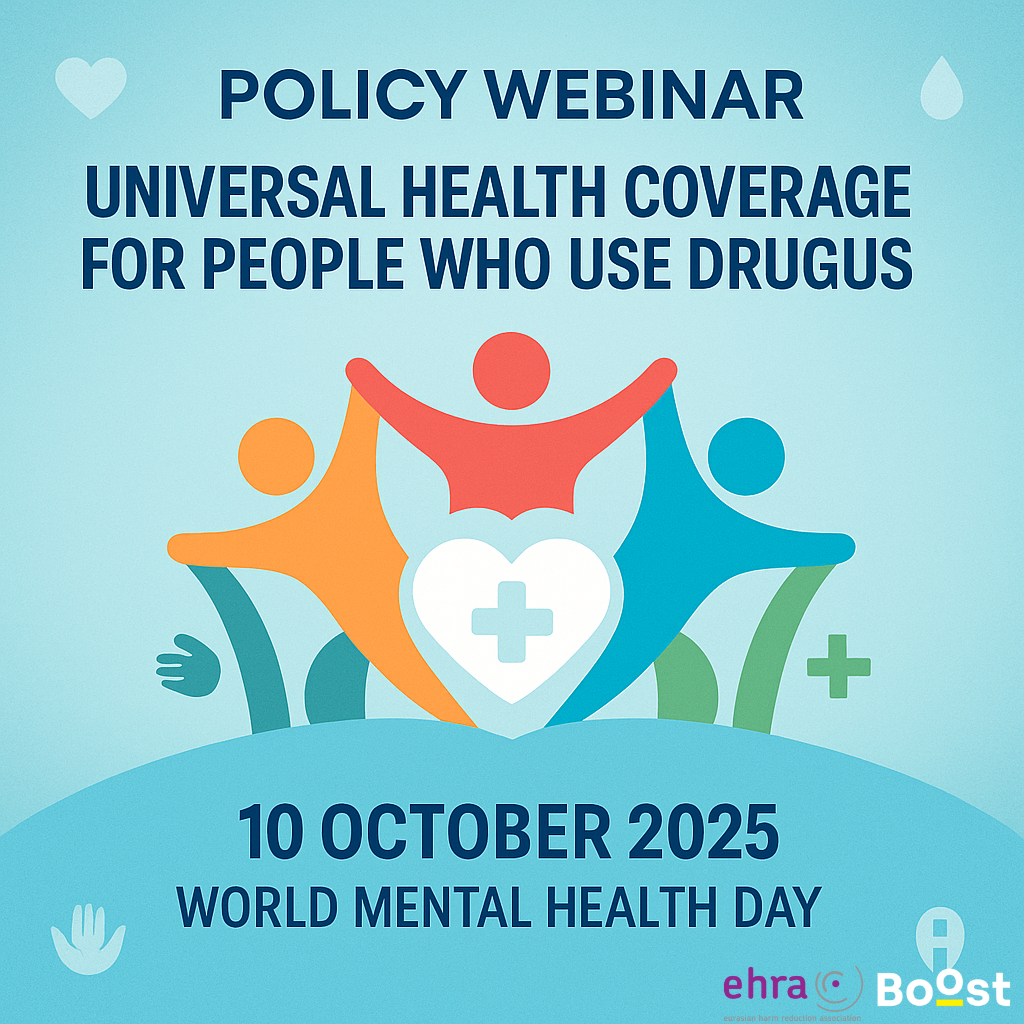
On 10 October 2025 (World Mental Health Day), the Eurasian Harm Reduction Association hosted a regional webinar under the EU4Health-funded BOOST project.
The webinar brought together speakers from WHO Europe, regional community networks and frontline services in Czechia, Lithuania and Romania. Participants joined from across Europe and neighbouring regions, including civil society organisations, community leaders, harm reduction professionals, clinicians and policymakers.
UHC that excludes PWUD is not universal
Opening the webinar, Ganna Dovbakh, Executive Director of EHRA, underlined that UHC cannot be called universal if it systematically excludes people who use drugs. She highlighted that in many countries, people who use drugs face a combination of criminalisation, stigma, fragmented services and poverty, which keeps them at the margins of health systems even where UHC frameworks formally exist.
Stela Bivol, from the WHO Regional Office for Europe, provided the global and regional policy context. She stressed that there is “no health without mental health” and no UHC without including people who use drugs and people with mental health and substance use conditions. She outlined WHO guidance on integrating mental health and substance use care into primary care, HIV and hepatitis services, and harm reduction, including the updated mhGAP recommendations and the new WHO clinical guidance on mental health and HIV.
Stela also drew attention to gender and intersectionality: women who use drugs, migrants, sex workers and LGBTIQ+ people often experience combined stigma, violence and rights violations that further reduce their access to care. Emergencies, such as the war in Ukraine, intensify mental health needs while disrupting services, making integration and task-sharing even more critical.
Communities as essential health actors
From the perspective of people who use drugs, Ligia Parodi (EuroNPUD) described UHC as “an empty promise” when people who use drugs are excluded by design through punitive drug policies and institutional discrimination. She stressed that fear of punishment, surveillance and institutional violence keeps people away from health services, and that many deaths and harms are the direct result of political choices.
Ligia highlighted community-led and peer-led initiatives, including BerLUN in Germany, Young Wave in Lithuania, and CASU and the women’s group MUSA in Portugal, which provide navigation, mutual support and advocacy on minimal budgets. These examples show that peers are already acting as health workers and system navigators, yet remain largely invisible and underfunded in UHC plans.
She called for decriminalisation, stable funding for community-led services, and meaningful participation of people who use drugs in decision-making bodies at national and EU levels, as well as in monitoring the quality and accessibility of UHC for key populations.
Integrated models from Czechia, Lithuania and Romania
The webinar showcased practical examples of integrating harm reduction and addiction care within UHC systems.
Radek Jurnikl (SANANIM, Czechia) presented a multidisciplinary outreach and low-threshold programme in Prague that combines social work, psychological support, nursing, psychiatric input and close collaboration with hospitals. The team provides street outreach, harm reduction services and on-site hepatitis C testing and treatment, as well as “hospital outreach” to ensure that patients discharged from hospital are immediately connected to OAT, shelter and follow-up support.
From Lithuania, Giedrius Likatavičius described the work of the Republican Centre for Addictive Disorders, which combines inpatient and outpatient care and runs an OAT programme with a dedicated budget line for people without health insurance. Social workers and nurses are embedded in low-threshold services to link clients to treatment and to HIV and hepatitis services. Lithuania’s model shows how mixed funding and dedicated lines for uninsured people can improve access, although stigma and weak financial incentives still limit decentralisation of OAT to primary care.
Monica Dan (ARAS, Romania) provided a contrasting picture from a more restrictive context. ARAS has offered harm reduction and OAT for decades, but services remain underfunded and not fully free of charge. Recent cuts to health insurance pathways have reduced access to treatment for many people who use drugs. At the same time, civil society must constantly resist new punitive legal initiatives. Monica underlined that without enabling legal frameworks and sustainable financing, even strong community-based services cannot deliver true UHC.
From evidence to advocacy
In the second half of the webinar, EHRA presented the joint BOOST advocacy strategy and the new policy brief: Advancing Universal Health Coverage for People Who Use Drugs in Europe, which translate these experiences into policy demands. The brief calls for harm reduction, OAT and mental health services to be explicitly included in UHC benefit packages; for peer navigators and low-threshold models to be recognised and funded; and for EU institutions to create or adapt funding mechanisms that reach community-led organisations.
Participants discussed the risk of over-medicalisation, the need to address self-medication and trauma, and the mental health needs of outreach workers and activists themselves. There was broad agreement that integrated and community-linked models are technically feasible and cost-effective, but remain politically fragile without decriminalisation, sustainable financing and meaningful community participation.
The webinar forms part of BOOST’s broader regional work on health, harm reduction and human rights. EHRA and partners will now use the policy brief and webinar outcomes to inform advocacy towards EU institutions, national governments and donors, ensuring that people who use drugs are not left behind in Europe’s push towards universal health coverage.
The recording from the webinar is available below


 The speakers presented the
