European Union Enlargement Country Reports

Traditionally, the European Commission adopted its annual assessment of the implementation of reforms in the Western Balkan partners and Turkey, together with recommendations on the next steps for those countries, and published its annual country reports. This year, due to coronavirus pandemic, the report was published in autumn, not in spring as it used to be.

The Commission adopted its Communication on EU enlargement policy and the 2020 Enlargement Package: The annual reports, assessing the implementation of fundamental reforms in the Western Balkans and Turkey, are presented together with clearer and more precise recommendations and guidance on the next steps for those partners, in line with the enhanced enlargement methodology.

The Commission also adopted a comprehensive Economic and Investment Plan for the Western Balkans, which aims to spur the long-term recovery of the region, a green and digital transition, foster economic regional cooperation, boost economic growth and support reforms required to move forward on the EU path.

Accession negotiations have been opened with candidate countries Montenegro (2012), Serbia (2014), and Turkey (2005). North Macedonia is a candidate country since 2005 and Albania since 2014. Bosnia and Herzegovina (application to join the EU submitted in February 2016) and Kosovo* (Stabilisation and Association Agreement entered into force in April 2016) are potential candidates.

As in the previous two years, DPNSEE extracted segments related to drugs from each of the country reports and packed them in one document. Same like in previous years, it is a pity to see that, almost exclusively, except some references to drug abuse prevention and harm reduction in Chapter 28: Consumer and health protection, the reports deal only with law enforcement related to drugs.

The document we prepared with reports for 2019 is downloadable following this link>>>.

Full versions of the Commission’s documents from 2018 are available following this link>>>.
 

New HIV infections increasingly among key populations

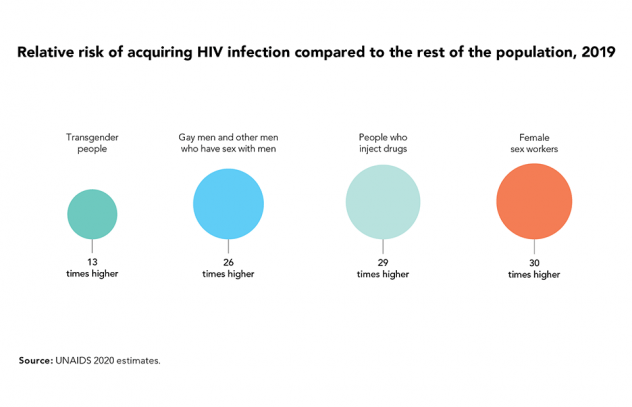
Key populations constitute small proportions of the general population but they are at higher risk of getting HIV, largely due to criminalization, discrimination and social exclusion. UNAIDS published their estimations for relative risk of acquiring HIV infection and distribution of new HIV infections by population for 2019.

In 2019, the proportion of new adult HIV infections globally among key populations and their sexual partners was 62%. This shift to an HIV epidemic increasingly among key populations is a result of the strong progress in HIV prevention in settings with high HIV prevalence in eastern and southern Africa, combined with a mixture of progress and setbacks in lower-prevalence regions.

Key populations – which include sex workers, people who inject drugs, prisoners, transgender people, and gay men and other men who have sex with men – constitute small proportions of the general population, but they are at elevated risk of acquiring HIV infection, in part due to discrimination and social exclusion.

Comparing to recent estimations, especially in the region of South East Europe, this is a significant increase of risk for the population of people who use drugs.

CIPHER Grant Programme

From the International AIDS Society website

The CIPHER Grant Programme directly supports the development of early-stage investigators, awarding up to US$150,000 for up to two years to address research gaps in paediatric and adolescent HIV in resource-limited settings. This is a unique “stepping up” opportunity, designed to give investigators the experience they need to compete for larger funding. The grants are resulting in personal and career development, capacity building on the ground, and research that informs policies and programmes.

Since 2013, CIPHER Grantees have been addressing key clinical and operational research gaps in paediatric and adolescent HIV. They are doing this where it is needed the most, in low- and middle-income countries (LMICs); in fact, recognizing the importance of building research capacity, CIPHER awards approximately 80% of funds to applicants from LMICs. The intention is to attract early-stage investigators – from inside and outside the field of HIV research – to address critical research questions while providing a unique opportunity for professional development.

CIPHER has partnered with the World Health Organization to develop global research agendas on HIV testing, treatment and service delivery for paediatric and adolescent populations. CIPHER implements these global research priorities as a funder through its grant and fellowship programmes.

The 2020/2021 round will focus on service delivery for HIV and related co-infections for paediatric and adolescent populations in resource-limited settings, including research on:

  • The impact of the COVID-19 pandemic on HIV and related co-infections service delivery
  • Community interventions to improve outcomes along the HIV cascade.

As the COVID-19 crisis disrupts health systems and affects human health globally, gains made in accelerating the HIV response for children and adolescents living with or affected by HIV could be reversed. This recognizes the need to strengthen service delivery models to improve quality of care and sustain efforts to achieve the AIDS Free targets. CIPHER aims to support research projects that could inform HIV policies and programmes, thus accelerating the HIV response in grantees’ countries.

CIPHER is pleased to accept applications in both English and French. To encourage more applications from young investigators in West and Central Africa, 50% of funds will be awarded to francophone applicants.

The CIPHER Grant Programme is made possible with the generous support of Founding Sponsor ViiV Healthcare. Its content is guided by experts in paediatric and adolescent HIV convened by the International AIDS Society.

To apply for the Programme, follow this link>>>.


Protecting communities: Responding to the impact of urban drug markets

More than half of the world’s population lives in cities, and it is predicted that by 2050 roughly two-thirds of all the people on our planet will live in urban areas. This creates opportunities but also challenges like drugs and organized crime.

Global Initiative Against Transnational Organized Crime is a network of over 500 independent global and regional experts working on human rights, democracy, governance, and development issues where organized crime has become increasingly pertinent.

Their new paper looks at the challenge posed by urban drug markets, particularly the impact on crime, safety, and development. It combines a granular local analysis – based on research as well as interviews with current and former gang members, police, drug users, social workers, court employees and representatives of civil society – with a broader transnational perspective. The study focuses in particular on drug markets in the cities of Cali, Colombia; Chicago, US; Cape Town, South Africa; Karachi, Pakistan; Kingston, Jamaica, and Rio de Janeiro, Brazil.

The paper first identifies the problems, types and impact of urban drug markets, and then examines what can be done about them. It looks at what can and is being done at the community level to strengthen local resilience to drugs within a broader context of improving urban management to make cities safe, resilient and sustainable (in line with UN Sustainable Development Goal 11 on sustainable cities and communities). The topic of protecting communities takes on added relevance as calls to defund the police open important debates about the limitations of militarized policing and create new opportunities beyond law enforcement to build safer communities.

In short, this study looks at the impact of urban drug markets: why they develop in some cities; how they manifest themselves; how they shape and are shaped by their environment; and what can be done to disrupt them and help nurture resilience in these communities.

To read the report, follow this link>>>.


On 5 October, World Habitat Day, The Global Initiative Against Transnational Organized Crime (GI-TOC) will convene a webinar to discuss contemporary challenges of making cities safer. The webinar will build on GI-TOC’s recent report Protecting Communities: responding to the impact of urban drug market. Among the topics to be discussed are:

  • The impact of COVID-19 on urban drug markets;
  • Militarized policing and its limitations;
  • How violence spreads like an epidemic – and how to interrupt it;
  • Lessons learned from alternative development for urban security;
  • Promoting safer communities in vulnerable neighbourhoods.

To join the webinar, .

Community Matters

The International Network of People who Use Drugs (INPUD), Mainline, King’s College London, AFEW International, the South African Network of People who Use Drugs, AFEW Kyrgystan and Rumah Cemarah shared the results of a three year research programme exploring how community involvement impacts the quality and accessibility of harm reduction services for people who use drugs. The research Community Matters: Lessons from a Bridging the Gaps research programme, supported through the Bridging the Gaps II programme, was completed from 2018 through 2020 as part of a community-academic partnership across Indonesia, Kyrgyzstan and South Africa which were linked to a ‘rapid review’ of the literature on low and middle-income countries.

Evidence from the report shows how difference forms of community involvement across these three countries impact harm reduction access and quality, especially in low and middle income settings. This evidence base can guide the scaling-up of community involvement efforts globally in support of harm reduction targets.

The report has four core messages:

  1. More ambitious support is needed for expanded community involvement in harm reduction services
  2. Community involvement can support increased access and quality of harm reduction services
  3. Community leadership delivers research with impact
  4. Research agendas need to expand and methodologies need to adapt

To read the report, follow this link>>>.


Serbia COVID-19 Socio-Economic Impact Assessment

The UN Country Team in Serbia launched the Socio-economic impact assessment of COVID19 in the country. It is the result of 26 assessments done by all UN agencies working in Serbia and non -resident ones, together with extensive fact finding exercise done jointly with Government.

This assessment provides an in-depth overview of the impact of COVID-19 on key economic and human development perspectives: health, social protection and provision of basic services, jobs and the economy, macroeconomic stability, community cohesion, governance and resilience, and the environment. It is framed around the UN Secretary-General’s framework for an immediate socio-economic response to COVID-19; it promotes more sustainable development and an opportunity to build forward better in the aftermath of the crisis, with an end goal of accelerating achievement of the 2030 Agenda for Sustainable Development (the “Agenda 2030”).

This report provides a comprehensive overview of COVID19’s impact in Serbia. It captures the situation in the first six months following the outbreak, based on official data and specific surveys conducted by UN agencies and other civil sector research. The report serves to inform the choices we make and actions we take in the coming period. These decisions will determine the outcome of this pandemic and the development of the region for decades to come.

To read the report, follow this link>>>.


A regulatory take on cannabis and cannabinoids for medicinal use in the European Union

The new review published by the Archives of Industrial Hygiene and Toxicology, takes a quick look at the current legal framework in the European Union which regulates cannabis use and cultivation for medicinal purposes. The document was prepared by Slovene Metoda Lipnik-Štangelj from the Faculty of Medicine, Department of Pharmacology and Experimental Toxicology, Ljubljana and Barbara Razinger from the Agency for Medicinal Products and Medical Devices of the Republic of Slovenia.

From the abstract

The discovery of the endocannabinoid system has raised public interest in the medicinal use of cannabis, phytocannabinoids, and synthetic cannabinoids, which has always been closely regulated due to their psychotropic effects and potential abuse. The review takes a quick look at the current legal framework in the European Union, which regulates cannabis use and cultivation for medicinal purposes in line with the United Nations Conventions on the production, trade, and use of cannabis, phytocannabinoids, and synthetic cannabinoids. And while the EU legislation precisely defines requirements and marketing authorisation procedures for medicinal products for all EU member states, there is no common regulatory framework for magistral and officinal preparations containing cannabinoids, as they are exempt from marketing authorisation. Instead, their regulation is left to each member state, and it is quite uneven at this point, mainly due to cultural and historical differences between the countries, leading to different access to non-authorised medicinal products. Therefore, to meet great public interest, harmonised approaches on cannabinoid-containing products without marketing authorisation would be welcome to level the playing field in the EU.

To read/download the review, follow this link>>>.


COVID-19 and HIV

Decades of investment in the HIV response have created platforms that are proving useful in battling COVID-19 – just as they were in responding to the 2014-2015 Ebola outbreak in western and central Africa.

The new report by UNAIDS examines how the experience of tackling HIV can help inform and guide effective, efficient, people-centred and sustainable COVID-19 responses.

This report focuses on three key issues: (1) how key lessons learned from the HIV response should inform COVID-19 responses; (2) how the HIV infrastructure is already driving COVID-19 responses and has the potential to catalyse accelerated progress through strategic action; and (3) how the COVID-19 response, informed by the history of responding to HIV, offers a historic opportunity to build a bridge to adaptable results-driven systems for health that work for people.

Key recommendations for the COVID-19 response include:

  • COVID-19 responses should benefit from learning from the HIV experience
  • Communities must be at the centre of COVID-19 responses
  • COVID-19 responses should be guided by human rights principles and practices
  • COVID-19 responses should be gender-sensitive and transformative
  • COVID-19 demands a multi-sectorial, all-of-government, all-of-society response
  • COVID-19 responses should leverage the HIV infrastructure
  • COVID-19 strategic information data must be used to guide action, increase accountability and improve programme performance
  • COVID-19 responses will require strong political leadership
  • We must use COVID-19 to reimagine systems for health

To read and download the report, follow this link>>>.


European Drug Report 2020

The European Monitoring Centre for Drugs and Drug Addiction (EMCDDA) launched today the European Drug Report 2020: Trends and Developments. In its latest annual review – marking 25 years of monitoring – the agency describes the drug situation at the end of 2019, along with recent changes brought by the COVID-19 pandemic in early 2020.

High availability across all drug types, drug production within Europe and highly potent substances are among the concerns addressed today. New developments highlighted in the report include: record cocaine, and large heroin, seizures; a scaling up of synthetic drug production; and concerns around high-potency cannabis, new synthetic opioids and ecstasy tablets containing high levels of MDMA. Drawing on new EMCDDA rapid studies (Spring 2020), the report also reviews COVID-19 disruption to drug use and the market, which could have long-term implications for Europe’s drug services and law enforcement agencies. There are fears that innovative drug distribution models developed during lockdown, along with the economic impact of the pandemic on vulnerable communities, will add to the challenges already posed by an abundant supply of drugs.

The following ‘Key issues’ have been identified in this year’s analysis:

  • Large drug shipments are increasingly intercepted
  • Cocaine’s role in Europe’s drug problem is increasing
  • Potential for increased heroin use and existing harms raise concerns
  • Understanding the public health impact of high-potency cannabis and new products
  • Increased and diverse drug production within Europe
  • Continuing availability of high-strength MDMA products highlights need for greater user awareness
  • Growing complexity in the drug market poses regulatory challenges and health risks
  • Need for new tools and innovative strategies to support the scaling-up of hepatitis C treatment
  • Drug overdose is increasingly associated with an ageing population
  • New psychoactive substances (NPS) have become a more persistent problem
  • Appearance of novel synthetic opioids is a worrying example of continuing market adaptability

To read the Report and get more information, follow this link>>>.

Presentations from the launch are available at Youtube:

Here is the video with a quick overview of the key issues covered in the European Drug Report 2020.

The Robert Carr Fund Fund’s 2020-2024 Strategy

The Robert Carr Fund has adopted the Fund’s strategy 2020 – 2024. The strategy was developed in a participatory process in 2019 and was officially launched at the AIDS2020 conference in July 2020.

The strategy will chart the Fund’s course through 2024. It is rooted in the strategic approaches of fostering a culture of learning and nurturing partnerships that benefit ISPs and advances three strategic priorities:

  • Movement leadership
  • Financial health and resilience
  • Innovation and creativity

To learn more about the Robert Carr Fund’s strategic priorities and approaches, please read the Strategic Plan 2020-2024 follow this link>>>.

You can also listen to the strategy presentation delivered during the AIDS2020, where it was discussed by the members of the civil society, International Steering Committee, and RCF Funders.

Craig McClure, the Chair of the ISC, emphasized that “The strategy builds on and amplifies the original vision for the Robert Carr Fund.  It aspires to a brighter future for civil society networks, while being grounded in a response to the unique challenges of our times“.