Call for speakers for CND 2020 Side Events

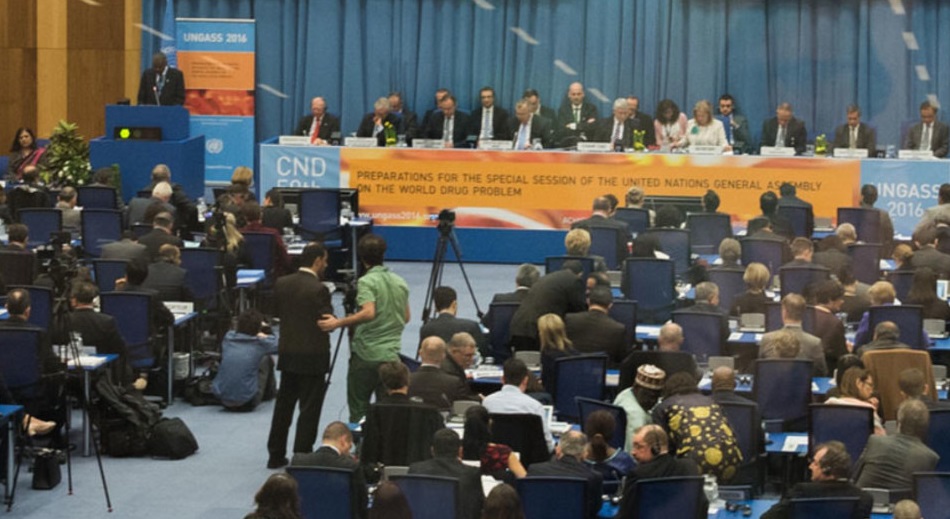
The Vienna NGO Committee on Drugs is co-sponsoring several side events at this years CND (12-16 April 2021) and has been asked to nominate speakers. All events will be held online.

The side events where civil society input is expected are:

  • Family a key social institution for addressing substance use, violence, mental health and promote sustainable development: Lessons learned from parenting under stress, in humanitarian settings and in the context of COVID19
  • VNGOC Ad Hoc Working Group, NGOs from Asia unite to create a consensus and a call for attention to the challenges in Asia regarding drug matters
  • No one left behind: UNODC-WHO Programme on Drug Dependence Treatment and Care
  • Insights into Treatment and Care for People with Drug Use Disorders in Contact with the Criminal Justice System: Alternatives to Conviction or Punishment
  • Civil Society & COVID-19 – responses during the pandemic

The length of the intervention will depend on the main organiser of the event but will likely be no longer than 5min.

Deadline for applications is 25 March, 11:45 p.m. CET.

To apply for the opportunity to present your experience, please follow this link>>>.


Protect civil society participation at the 64th CND

The Vienna NGO Committee on Drugs (VNGOC) – the global network of nearly 300 NGOs with the purpose of coordinating and supporting meaningful participation at the CND and other fora – published an urgent position statement. Ahead of the 64th CND in April, with its new hybrid format, the statement outlines our recommendations and expectations for the effective, meaningful participation of civil society online.

The statement can be found at:

VNGOC urge all UN member states to ensure that the modalities for the hybrid 64th session do not inadvertently close the space for civil society to play its important role in these deliberations.

735 drug induced deaths in Serbia since 2008

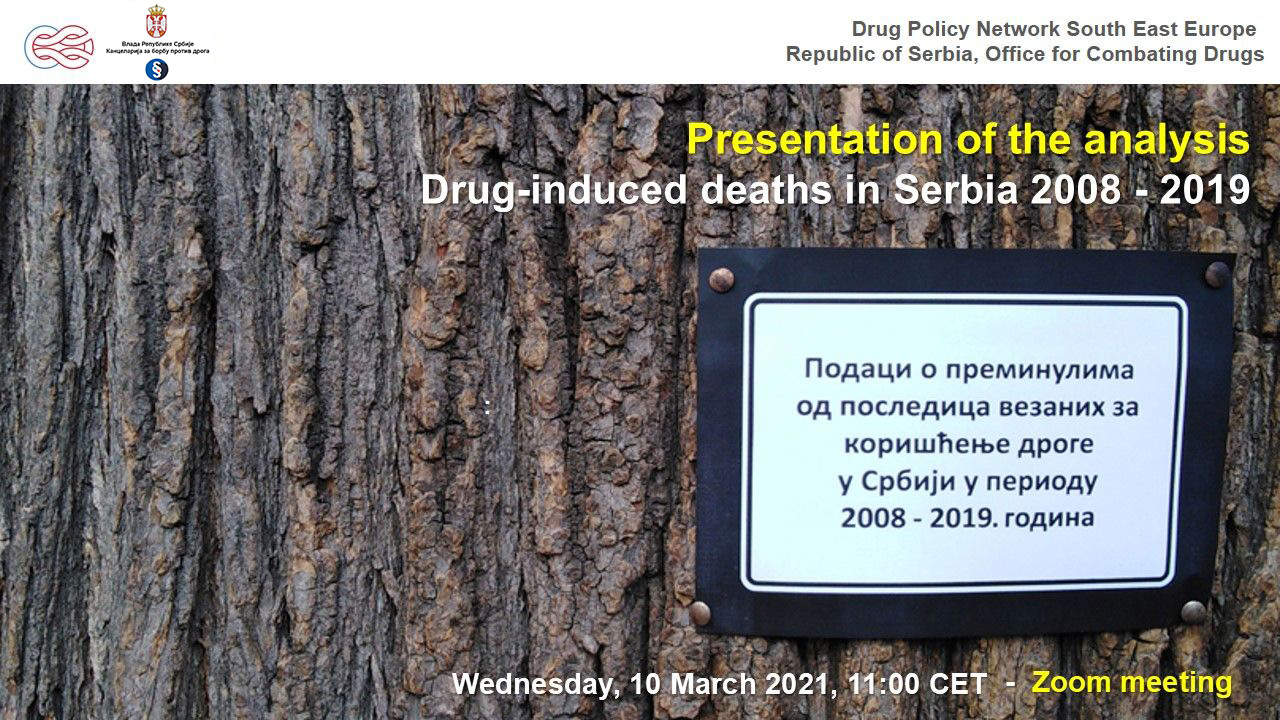
The Drug Policy Network South East Europe held the promotion of the Analysis of the data on drug-induced deaths in Serbia 2008 – 2019 on 10 March 2021 with the support of the Office for Combating Drugs of the Government of the Republic of Serbia.

The presentation with bilingual data (Serbian and English) is available following this link>>>.

More than 30 representatives of governmental organisations, civil society organisations, media and international organisation from Serbia and other countries participated.

The discussion emphasized the need to better report deaths and analyse the data so that we may better protect people who use drugs from overdose and loosing life.

The Analysis is available following this link>>>.


Impact of COVID-19 on drug use and drug services in Western Balkans

The Western Balkans (Albania, Bosnia and Herzegovina, Kosovo*, Montenegro, North Macedonia and Serbia) registered the main waves of COVID-19 infections later than most of the EU countries, but containment strategies were implemented at the same time and with equal force as in the rest of Europe.

The European Monitoring Centre for Drugs and Drug Addiction (EMCDDA) published Trendspotter briefing: Impact of COVID-19 on drug use and drug services in Western Balkans. This report provides the main results of studies conducted using the trendspotter methodology to explore the impact of the pandemic and associated measures on drug services and people who use drugs in the Western Balkan region.

DPNSEE and our member organisations contributed to the report with information and case studies from the ground.

The main findings are listed below.

  1. Use of alcohol, benzodiazepines, and cocaine was reported to have increased in some subpopulations of people who use drugs. Use of benzodiazepines in combination with opioids was among the common risk behaviours observed during the first weeks of lockdown.
  2. A number of harms were observed among marginalised and injecting drug users, who in some cases lacked resources to satisfy basic needs. Mental health problems were reported among both recreational and problem drug users.
  3. The provision of drug treatment was reduced during the first weeks of the pandemic, affecting mainly new admissions and services provided face to face.
  4. The number of people entering treatment declined between March and May 2020 in almost all countries in the Western Balkan region.
  5. Opioid substitution treatment (OST) centres and harm reduction services mainly remained operational, although under a restricted regime.
  6. The main adaptations to the new situation included use of telemedicine and a relaxation of OST distribution schemes.
  7. Personal protection measures became standard in all treatment and harm reduction facilities, and protective equipment was distributed to clients whenever possible.

The crisis highlighted the fragile position of some service providers and the reliance of harm reduction services on the support of international donors.

To read the full report, follow this link>>>.


Board preparations for the General Assembly

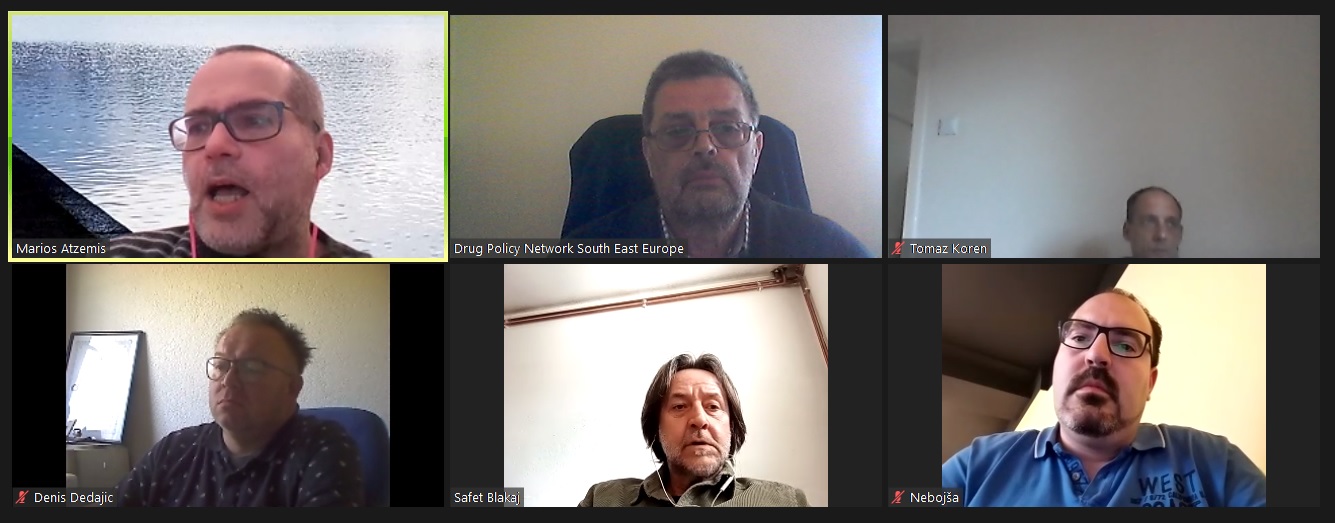
The Board of the Drug Policy Network South East Europe, at meeting the held by Zoom on 8 March 2021, discussed preparations for the annual General Assembly.

The Board decided that the General Assembly will be held via Zoom on Monday 29 March 2021.

The member organisations are invited to send information about their official representatives by Monday 22 March. The registered representatives will get the link to the Assembly and password so that we are able to establish quorum and organise voting.

The Board was informed that the Greek Users Union “Peer Network of Users of Psychoactive Substances – PeerNUPS” has a legal status and that they will request membership in the Network. The Board supported this application and proposes that community organisations don’t have the obligation to pay membership fees for several years until they achieve sustainability.

The Board noted that Ilinka Serdarević submitted her resignation due to personal reasons which prevent her to perform this position in full capacity. The Board thanks Ilinka for her significant contribution to the work of the Network and hopes that she will continue supporting us.

In accordance with the Article 18 of the DPNSEE Statutes, the Board invited member organisations to propose candidates for co-opting. The Board reminds that this article defines that “The composition of the Board shall reflect the entire diversity (geographical, gender, ethnic) of the Network” and warmly welcomes candidatures from countries which currently we don’t have a Board member (Albania, Bulgaria, Croatia, North Macedonia and Romania). The Board strongly supports and invites women and representatives of the community of people who use drugs to apply.

The Board was informed that DPNSEE signed the contract with the Regional Youth Cooperation Office on 23 February for implementation of the project No risk, no borders for young people. The first activities of the project already started, including a consultative meeting of the project partners, the call for logo and visual identity is already open, scheduling workshops and the first planning meeting of the project team.

The Board also discussed the process of finalising the agreement with the EU TACSO 3 to get support for Adjusting the DPNSEE Strategy to the new reality caused by the coronavirus pandemic and designing the Public Relations and Communication Strategy and communication with several partners on potentials for preparing a project proposal for the Supporting Initiatives in the field of drugs policy – a big call from EU, aimed for strategic, long term projects related to drug policy.

The Board concluded that we DPNSEE is not invited to participate in preparations of the multi-country project to the Global Fund. The Board finds this process as not fully transparent and based on a comprehensive evaluation of needs of our region and deprives some countries of South East Europe.


Drug-induced deaths in Serbia

The Office for Combating Drugs of the Government of Republic of Serbia and the Drug Policy Network South East Europe (DPNSEE) invite you to the promotion of the analysis of the data on drug-induced deaths in Serbia 2008 – 2019.

DPNSEE has prepared the analysis using statistic about the drug-induced deaths managed by the Statistical Office of the Republic of Serbia. The data used are segmented using codes of the causes of death, agreed with the Ministry of Health and the Institute for Public Health “Dr Milan Jovanović Batut”, in accordance with the standard protocol of the European Monitoring Centre for Drugs and Drug Addiction (EMCDDA).

The statistics include annual tables presenting number of those passed away by different indicators: gender, age, location, substance that caused death, consequence of long term use or accidentally, etc.

The presentation will be held in Serbian with translation into English via Zoom at the following link https://us02web.zoom.us/j/86941798054 on Wednesday 10 March 2021 starting at 11:00 CET. The presentation would last for approximately 60 minutes.

For all additional information, please contact us using followong email addresses kabinet@kzbpd.gov.rs or office@dpnsee.org.


Consultancy to review HIV landscape and opportunities in South Eastern Europe and the Baltic States

The Elton John AIDS Foundation is seeking a consultant to conduct a review of HIV-related systems, programming and opportunities in South Eastern Europe and the Baltic States to help maximise the impact of the Foundation’s grant investments in the Eastern Europe and Central Asia (EECA) region.

The consultant will support the Foundation, as one of the largest philanthropic donors for HIV related programming in EECA, in its objective to help end the AIDS epidemic in the region.

The consultant will:

  • Analyse the landscape of governmental and non-governmental systems and programming related to HIV prevention, treatment and care, and harm reduction activities for people who use drugs, sex workers and LGBT people on the regional level and in the following countries: Albania, Bosnia and Herzegovina, Bulgaria, Croatia, Estonia, Kosovo, Latvia, Lithuania, Montenegro, North Macedonia, Romania, Serbia, and Slovenia.
  • Identify strategies and opportunities to achieve sustainable progress on HIV prevention and care, harm reduction and stigma outcomes for people who use drugs, sex workers and LGBT people in the South Eastern Europe and Baltic regions. Recommended strategies and opportunities for programming and advocacy should consider potential value-add of Elton John AIDS Foundation investment and feasibility.

Applications will be welcomed until 11 March2021 at 16:00 GMT.

More information is available following this link>>>.


Drugs to be regulated around Europe

This year started with a few interesting news about actions to regulate drugs. Here is a glimpse from the news from three European Union countries.

Icelandic Government Proposes Drug Decriminalisation

In the second part of January, the Icelandic government has proposed the decriminalisation of drugs for personal use by adults and launched a consultation exercise to gauge public opinion on the matter. The public consultation is open until 31 January.

The initiative, led by Minister of Health Svandís Svavarsdóttir, is intended as a harm-prevention measure. It includes the provision of additional resources to support users, with particular focus on more marginalised members of society.

This new approach is based on regarding users as patients rather than criminals and follows the minister’s successful introduction last year of a bill to provide safe spaces for drug injection.

The original article is available following this link>>>.

Malta will allow users to grow cannabis plants for personal use

Prime Minister on Malta Robert Abela, on 18 February when speaking to journalists, announced that cannabis users should not go to jail and will be able to grow a limited amount of plants as he fleshes out some aspects of government’s proposed reform. Abela said Cabinet will shortly be discussing a White Paper that will be published for public consultation. The reform is being piloted by Reforms Parliamentary Secretary Rosianne Cutajar.

He said the reform will end police arrests for people caught in possession of a small amount of cannabis and hinted that the current limit of 3.5g allowed at law would increase.

It was a Labour Party electoral pledge to initiate a discussion on the legalisation of cannabis but so far, no formal proposals have been put forward despite ongoing consultations.

The original article is available following this link>>>.

Norway to Decriminalize Personal Drug Use in ‘Historic’ Shift

Norway plans to decriminalize the personal use of illegal drugs in small quantities, citing recommendations from the United Nations and the World Health Organization.

The Nordic country will abolish criminal liability “for the use of drugs and the acquisition and possession of a small amount of drugs for own use,” according to legal proposals by the health-care ministry to lawmakers, published on Friday. The acts will be illegal, but not punishable.

Norway, along with its Nordic neighbours, has some of Europe’s highest drug-induced mortality rates. In contrast, the region’s welfare systems rank among the best globally. Norway had 66 cases of drug-related deaths per million adults in 2017, compared with an average of 23.7 for the European Union, according to the European Monitoring Centre for Drugs and Drug Addiction.

The police will confiscate the below-threshold drugs found on any person, who will then be ordered to appear at a municipal advisory unit.

The original article is available following this link>>>.


Call for CSFD members

European Commission has opened the Call for applications for members of its expert group the Civil Society Forum on Drugs (CSFD). As the membership of the Group will be completely renewed for 2021-2023, the Commission is calling for applications with a view to selecting members of the group.

The Forum membership comprises 45 civil society organisations coming from across Europe and representing a variety of fields of drug policy, and a variety of stances within those fields.  Its purpose is to provide a broad platform for a structured dialogue between the Commission and the European civil society which supports drug policy formulation and implementation through practical advice.

Members shall be organisations in the broad sense of the word, including associations, Non-Governmental Organisations (NGOs), trade unions, universities and research institutes, and other organisations, if relevant to EU drugs policy, and individuals appointed in a personal capacity.

The Call is available following this link>>>.


TACSO supports DPNSEE Strategy review

DPNSEE is among 10 selected civil society organisations (CSOs) from the Western Balkans and Turkey Region for the Strategic Mentoring Programme. The Programme is a part of EU TACSO 3 Capacity Development and People to People (P2P) Programme. It enables interested and qualified organisations to get an in-depth mentoring support to improve areas of their work according to their needs and in line with EU TACSO 3 project priorities.

In total, forty-three (43) requests were received as the response on the EU TACSO 3 open call out of which ten (10) are allocated mentoring support. During the assessment process, the quality of applications, types of organisations as well as geographical and thematical coverage were taken into consideration.

The Strategic mentoring support is composed of targeted hands-on capacity development support to selected CSOs, tailored to individual organisations and pragmatic resulting in concrete outcomes. Support includes assessments, meetings and consultations, workshops and support in development of concrete documents (i.e. plans, strategies, internal procedures and documentation etc.).

DPNSEE have applied for support to review the network’s Strategy and develop the Public Relations and Communication Strategy. The Strategic Mentoring support will be implemented until November 2021.