The Global Fund Board has approved in February additional funding for portfolio optimization, funded from the Register of Unfunded Quality Demand (UQD), in the amounts of 135.666,553 USD and 25.693.664 €, for 28 grants in 23 countries. The funds come from 650 million USD approved by the Audit and Finance Committee for portfolio optimization to fund high-impact interventions from the Register of Unfunded Quality Demand, linked to grants in the 2017 – 2019 funding cycle. The additional amounts will be integrated into the 28 existing grants through grant revisions that increase each grant’s upper-ceiling amount.
Also, The Global Fund Board has approved the Secretariat’s recommendation to allocate 43,3 million USD in additional funding to several countries and grants including Kosovo (HIV/AIDS). These additional funds come mostly from unutilized funds within grants, often because of countries’ lower-than anticipated rate of funds’ absorption. In addition to previously approved program budget of 1.445.502 €, recommended additional funding is for 112.010 €.
The additional 112,010 will support Kosovo’s HIV grant, specifically activities to reduce human rights-related barriers to HIV services, community responses, and systems for social mobilization, building community linkages, collaboration, and coordination. These funds will also pay for capacity building for community health workers.
 The Principal Recipient for Kosovo is the Community Development Fund.

 The International Federation of Red Cross and Red Crescent Partnership on Substance Abuse, co-sponsored by the Government of Italy, UNODC, WHO, in cooperation with the Levenson Foundation, the C4 Recovery Foundation, PTACC and the Villa Maraini Foundation, has launched the Manifesto “Rome Consensus 2.0 towards a humanitarian drug policy” at the 63a CND at UNODC in Vienna.
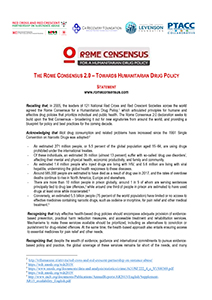 The Rome Consensus 2.0 is available

 The briefing offers information about:
 The UNODC Prevention Treatment and Rehabilitation Section (PTRS) in coordination with WHO and UNHCR is planning a consultation process to develop a technical guidance tool to address substance use and substance use disorders, as well as associated health and social consequences in Relief and Humanitarian Settings and to increase access to substance use disorder treatment also in Humanitarian Settings. An expert group meeting is tentatively scheduled for the third quarter of 2020.
 In the
 The International Drug Policy Consortium (
 The International Network of People who use Drugs (
 To read full and download the tool,