An interesting dialogue on evidence and recommendations on decriminalisation

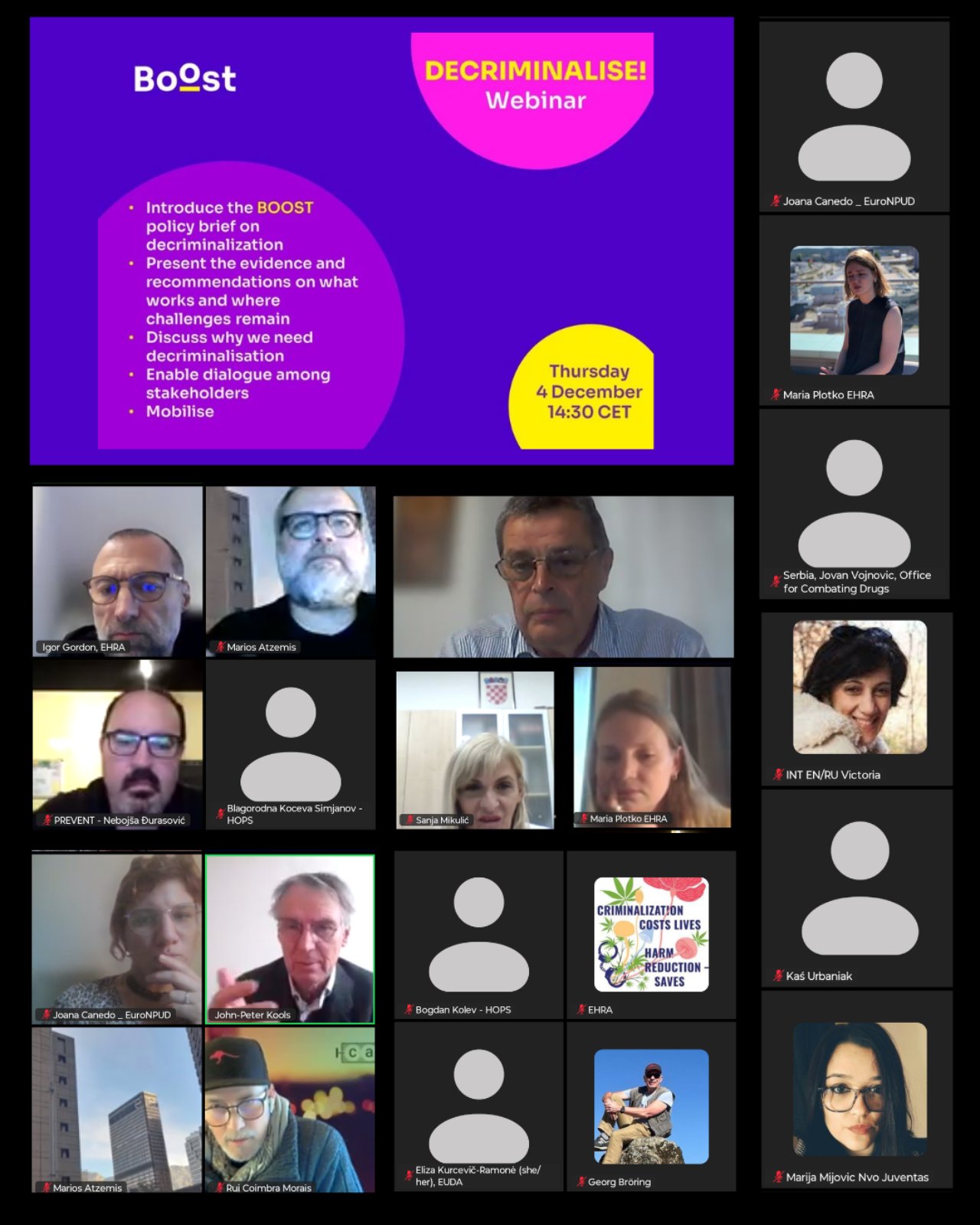
Together with our project partners C-EHRN, EHRA, EuroNPUD, the Drug Policy Network South East Europe hosted a Webinar on Decriminalisation of drug use and possession for personal use on 4 December 2025. The aim of the webinar was to present and discuss a policy brief developped in scope of the BOOST project.

The webinar was held in English and Russian. 32 participants from various European countries participated – experts, activists, and policymakers. They demonstrated that the true threat to European safety is not the substances themselves, but a punitive system that costs taxpayers billions, fuels organized crime, and destroys lives.

Marios Atzemis, DPNSEE Board member, presented the policy brief ondecriminalization, highlighting its importance for health, dignity, and human rights, and shared personal experiences on the impact of criminalization.

The fiscal and moral bankruptcy of criminalization

The conversation at the webinar began not with ideology, but with hard accounting. For years, governments in Central and Eastern Europe and Central Asia (CEECA) have claimed they “cannot afford” comprehensive harm reduction services. New data presented by EHRA Executive Director Ganna Dovbakh exposed this as a fiscal lie.
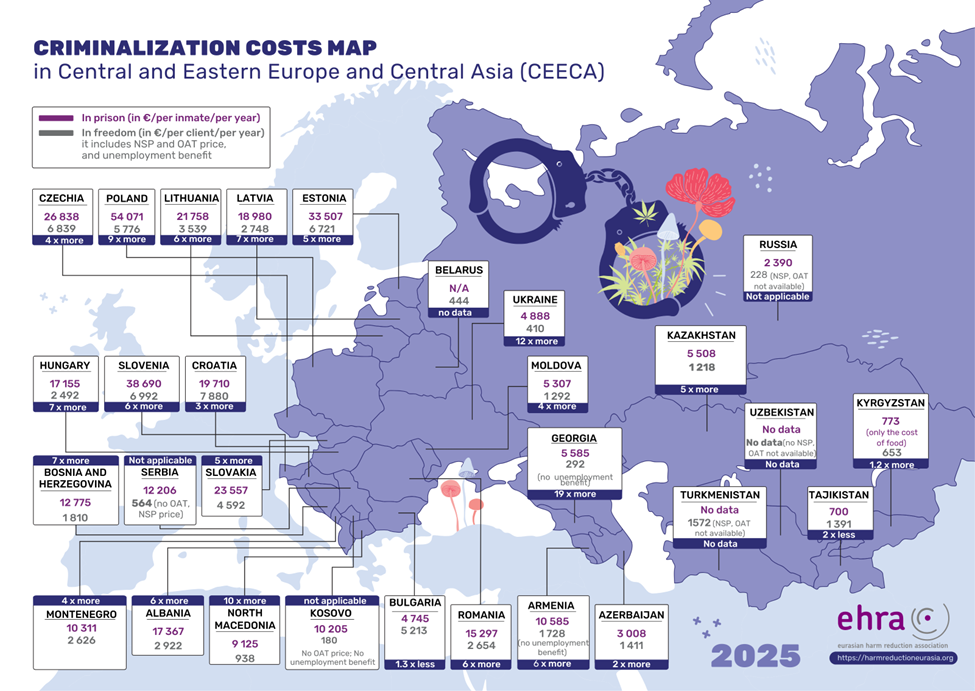
Presenting an updated 2025 comparative analysis of criminalization costs, Dovbakh revealed a staggering gap: in many CEECA countries, imprisoning one person for a drug offense costs the state up to 19 times more than providing that same person with a full package of health and social services (including Opioid Agonist Treatment and harm reduction) in the community.


A full regional comparison and country profiles are available following this link>>>.
But the cost is not merely financial; it is human. To expose this reality, Maria Plotko (EHRA) unveiled “Drug Policy and Economic, Social and Cultural Rights in the CEECA Region” a vital new resource developed by EHRA in partnership with the Helsinki Foundation for Human Rights (HFHR).

Designed to inform the upcoming UN CESCR General Comment, this report acts as a roadmap for civil society, documenting how punitive policies violate rights far beyond the traditional scope of health. The findings-based on consultations across 19 countries reveal a system of “invisible punishment”:

  • Right to Work: Administrative fines often lead to total wage garnishment, forcing people out of the formal economy, while rigid OAT schedules and workplace testing prevent stable employment.
  • Right to Family: In countries like Uzbekistan and Tajikistan, mandatory testing is required before marriage, and people with a history of drug use are often barred from adopting children.
  • Social Security & Housing: “Drug registries” create a catch-22 where individuals are denied state support or housing eligibility based on their status.

The Netherlands: Fixing the “Back Door” Paradox

John-Peter Kools of the Trimbos Institute provided a critical reality check on the famous “Dutch Model.” He clarified that the Netherlands does not have full de jure decriminalisation, but rather a 50-year-old policy of “tolerance.”

While this separation of markets (coffee shops) successfully decriminalised consumption, it left a dangerous legal gap: the supply chain remained illegal (the “back door” problem). This created a paradox where sale is tolerated, but production is criminal, empowering organized crime.

To solve this, Kools highlighted the Netherlands’ bold new step: The Controlled Cannabis Supply Chain Experiment. Currently rolling out in 10 cities, this pilot legalises the entire chain from production to sale. “Decriminalisation of use is not enough,” Kools noted. “Without regulating the supply, you leave the market to criminal networks.” He emphasized that local innovations – cities leading the way – are often the precursors to necessary national reform.

Croatia’s Drug Decriminalization Experience

Sanja Mikulić, from the Institute for Public Health, presented Croatia’s experience with drug decriminalization, noting that possession forpersonal use is treated as a misdemeanor punishable by fine or treatment, with a significant reduction in criminal cases and less pressure on the justice system. She highlighted that th eapproach has led to more flexible procedures, reduced stigma, and easier rehabilitation, while alsosaving budget funds. The presentation concluded with positive effects of decriminalization, including reduced cases in criminal courts and more focus on serious drug-related crimes.

The warning from Portugal: why decriminalization is no longer enough

For two decades, Portugal has been the global poster child for reform. However, Joana Canêdo, a researcher and activist from Lisbon, delivered a critical warning: stagnation is dangerous.

While the 2001 decriminalization model famously reduced HIV rates and overdoses, Canêdo described the current system as a “prohibitionist variant.” The “Dissuasion Commissions,” once hailed as innovative, have become bureaucratic bottlenecks. Approximately 90% of those referred to them are non-problematic users (mostly of cannabis) who do not need treatment yet are subjected to a coercive administrative process.

Crucially, because the market remains illegal and unregulated, the system is struggling to adapt to new trends like crack cocaine. With recent political shifts in Portugal, aggressive policing and stop-and-search tactics have returned. The lesson for the rest of Europe is clear: Decriminalization without legal regulation and continuous investment in services will eventually hit a wall.

The pragmatic revolution: Czechia

However, the most significant innovation is occurring in Czechia. Dr. Jana Michailidu detailed the country’s revolutionary approach to “Psychomodulatory Substances” (such as Kratom and semi-synthetic cannabinoids).

Faced with a surge in new psychoactive substances, Czech politicians initially tried bans. When those bans failed immediately with new chemical analogues appearing weeks later, the government pivoted. They passed legislation creating a strict regulatory market. These substances are not banned, but neither are they unregulated. They are sold only to adults in licensed stores, with strict controls on dosage and packaging.

We managed to convince conservative politicians that regulation protects children better than bans” Dr. Michailidu explained. By taking the market out of the shadows, the state can control access – something prohibition has never achieved.

In her closing remarks, Ganna Dovbakh dismantled the metric favored by the new EU Strategy: the “kilogram seized.” She termed this the “Kilogram Fallacy.” Seizures are merely an indicator of police activity, not policy success. “You stop one route, ten more appear. You ban one substance; laboratories produce ten new ones. We are fighting a fire with a leaking hose” she argued.
 

Webinar on decriminalisation

Policy Webinar under the BOOST Project

4 December 2025 | 14:30–16:00 CET

Registration link | https://us02web.zoom.us/j/89055986872

Languages: English and Russian


Background and Rationale

Decriminalisation is defined as the removal of criminal sanctions for certain activities related to drug use and possession for personal use. Several actors in the field of drug policy have indicated that a punitive approach is counterproductive to achieving the health and welfare of humankind. There is no evidence that criminalisation of use, possession for personal use, and other related behaviours has positive impacts in terms of reducing both drug demand and supply.

Purpose and Objectives

  • Introduce the BOOST policy brief on decriminalisation to stakeholders across Europe: policymakers, community-led organisations, practitioners, funders
  • Present the evidence and recommendations on what works and where challenges remain when discussing about and adopting decriminalisation
  • Discuss why we need decriminalisation and what arguments can help and how to achieve this goal?
  • Enable dialogue among stakeholders decriminalisation: barriers, enablers, local contexts
  • Mobilise institutions, experts, communities and civil society networks to use the brief as an advocacy tool

Programme

Time Segment
14:30 – 15:37 Opening & overview – Milutin Milošević, DPNSEE Executive Director, Moderator
14:38 – 14:45 The BOOST project: General information and advocacy interventions – Igor Gordon, Program Team Lead, EHRA
14:45 – 14:55 The BOOST policy paper “Decriminalize! drug use and possession for personal use” – Marios Atzemis, DPNSEE Board member
14:55 – 14:05 Presentation of the new documents related to decriminalisation and human rights violations – Ganna Dovbakh, Executive Director and Maria Plotko, Senior Program Officer, EHRA

·      Updated Criminalisation Cost country profiles and regional comparison for CEECA

·      Regional CEECA report on CESCR rights violations of people who use drugs

15:05 – 15:15 Experts from countries implementing decriminalisation – John-Peter Kools, Trimbos institute, The Netherlands
15:15 – 15:22 Experts from countries implementing decriminalisation – Sanja Mikulić, Institute for Public Health, Croatia
15:23 – 15:30 Experts from countries implementing decriminalisation – Joana Canêdo, Portugal
15:30 – 15:38 Experts from countries implementing decriminalisation – Dr. Jana Michailidu, Czechia
15:40 – 15:55 Questions and answers
15:55 – 16:00 Closing – Ganna Dovbakh, EHRA Executive Director and EU Civil Society Forum on Drugs Chairperson


New policy brief calls for a decriminalisation model whereby all drugs are decriminalised

The criminalisation of use, possession for personal use, and other related behaviours may have negative impact on people who use drugs, local communities, and the whole society, particularly in terms of access to health and social services.

Several actors in the field of drug policy have indicated that a punitive approach is counterproductive to achieving the health and welfare of humankind and many UN agencies have reported the negative impact of criminalisation on people who use drugs and on their surrounding communities.

The decriminalisation of drug use and related activities is a policy option that is widely supported as a core component of a human rights- and health-based approach towards people who use drugs. Decriminalisation refers to the removal of criminal status from a certain behaviour or action. This does not mean that the behaviour is legal, as non-criminal penalties may still be applied. This process aims to remove the stigma against people who use drugs as well as to ensure that they have access to a broad range of support and health services, including prevention, treatment, recovery, and harm reduction.

This publication, prepared by the Drug Policy Network South East Europe, is part of the EU-funded BOOST project, which supports community-led advocacy for inclusive health systems across Europe.

Read the full policy brief here>>>.


Investing in decriminalisation advocacy

DPNSEE President Nebojša Đurasović and Executive Director Milutin Milošević participated in the meeting of the National Commission for Fighting HIV/AIDS and Tubercolosis in Serbia (also performing the role of the national Country Coordination Mechanism for the Global Fund support). The meeting was held from 16 to 18 July in Banja Koviljača.

On our proposal, the Commission decided to invest part of the savings from the 2023 implementation of the Global Fund supported project “Support to the activities of citizens’ associations in the field of prevention and control of HIV infection” in the campaign for decriminalisation of drug use and possession for personal use.

DPNSEE have already presented the initiative for the decriminalisation of the use and possession of drugs for personal use on two occasions at Commission meetings. In addition, the Drug Policy Network South East Europe officially submitted the initiative to the Ministry of Justice and presented it at the meeting of the Working Group for Amending the Criminal Code and the Working Group on Amending the Law for the Criminal Procedure Code with the Working Groups on Chapters 23 and 24 of the National Convention on the European Union held on 21 December 2023. The initiative was supported at this meeting. Modalities for accepting the initiative and the draft that will be submitted to the National Assembly for adoption (as well as other initiatives to amend these two important laws) will be discussed at thematic discussions; the topic of one of the first discussions planned will be our decriminalisation initiative.

Advocacy is supposed to include:

  • Collection and analysis of the decriminalisation models and the results they have achieved in countries that have decided to take this step
  • A study visit of 5 representatives of civil society institutions and organizations to Portugal or Switzerland
  • An expert meeting where the arguments for and against and the modalities of decriminalisation that would suit our conditions would be analyzed. People who use drugs, drug addicts, and those in recovery, as well as civil society organizations will participate in this meeting. Representatives of countries that have already decriminalized drug possession and use, primarily Slovenia and Croatia, will present their experiences. A proposal to amend Article 149 and remove Article 250 from the Criminal Code, which specifically stigmatizes and discriminates against people living with HIV, would also be presented at the meeting, as well as the initiation of amendments to the Law on Public Order and Peace, which criminalizes sex work.
  • Agreeing on the final proposal to amend the Criminal Code
  • Organization of thematic workshops on the topic of discrimination and decriminalization of people who use drugs, people living with HIV and sex workers

Oregon’s U-turn on drug decriminalisation

Measure 110, which made Oregon the first state in the United States to remove criminal penalties for possession of a small amount of any drug, was and remains a historic turning point for the decriminalization movement. Sadly, the Oregon legislature has partially repealed the measure, creating new “drug enforcement misdemeanors” punishable by a term of supervised probation or up to 180 days in jail. Instead of taking steps to improve the health-based model, the legislature doubled down on criminal penalties, bowing to political pressure and an intense misinformation campaign by opponents, including the former chief of the prison system, business interests and law enforcement. Though this is undoubtedly a setback, Measure 110’s impact will reverberate for years to come.

What happened? And what lessons should we take to strengthen future decriminalisation reforms?

Read more at IDPC blog following this link>>>.


Position paper on decriminalisation

Decriminalisation is defined as the removal of criminal sanctions for certain activities related to drug use and possession for personal use.

Several actors in the field of drug policy have indicated that a punitive approach is counterproductive to achieving the health and welfare of humankind. Many UN agencies have reported the negative impact of criminalization on people who use drugs and on their surrounding communities. Recommendations have also been brought that favour a decriminalisation process in drug policies. This process aims to remove the stigma against people who use drugs as well as ensure that they have access to a broad range of support and health services, including prevention, treatment, recovery, and harm reduction. The decriminalisation of drug use and related activities is a policy option that is widely supported by the United Nations as a core component of a human rights- and health-based approach towards people who use drugs.

The current EU Drug Strategy 2021-2025 endorses alternatives to coercive sanctions as an approach that respects the human rights of people who use drugs.

While some EU member states retain a stance of criminalising personal use and related behaviours in their national legislation, several member states have already decriminalised use and possession for personal use, and various EU member states have bills in their parliament to take that step as well.

The Civil Society Forum on Drugs (CSFD), an expert group of the European Commission, is of the opinion that the perspective established by the EU Strategy 2021-2025 – a balanced, human rights-based approach to drug policy – needs to be improved at the EU level and in member states.

After almost two years of discussions and balancing often oposite positions, CSFD produced this Position paper. DPNSEE is proud of being involved and even managed the process of agreeing on the final version of the document.

To access the Position paper, follow this link>>>.


Drug Decriminalisation [e]Course

The International Dug Policy Consortium (IDPC) in partnership with Mainline, Health[e]Foundation and Frontline AIDS designed the Drug Decriminalisation [e]Course to support and equip partners from around the world to advocate for the decriminalisation of drug use and personal possession.

The Course includes seven modules:

  1. Introduction, definitions and support for decriminalisation (Available in English and French)
  2. Existing models of decriminalisation (Available in English and French)
  3. Making the case for decriminalisation (Available in English and French)
  4. Designing decriminalisation – part 1: selecting the model of decriminalisation (Available in English)
  5. Designing decriminalisation – part 2: defining drug possession for personal use (Forthcoming)
  6. Designing decriminalisation – part 3: sanctions and intrusiveness (Forthcoming)
  7. The ‘gold standard’ for decriminalisation (Forthcoming)

Ahead of the December break, I share the good news that Module 4 was presented. It is the first of three modules delving into the complex and important challenge of designing decriminalisation models, addressing key issues such as the model’s normative basis and key decision-makers.

This e-course was designed to strengthen our movement’s capacity to advance effective and full decriminalisation and is entirely free.

To register and access the course click here>>>.


Cannabis decriminalised in Luxembourg

Source: Herb

On Friday, Luxembourg’s government announced that citizens would be permitted to grow up to four cannabis plants on their property, making it Europe‘s first official country to decriminalise the production and consumption of cannabis, noted The Guardian.

The announcement follows Luxembourg’s government’s pursuit to provide fundamental changes towards the country’s perspective and view on recreational cannabis cultivation after failing to prohibit the drug. Now, people 18 and older are legally allowed to grow their own cannabis, up to four plants per household. Seeds received via trading are also deemed legal without having to specify the THC content. Luxembourg’s government also said that users could obtain seeds from shops, importation, or online purchases.

“The idea is that a consumer is not in an illegal situation if he consumes cannabis and that we don’t support the whole illegal chain from production to transportation to selling, where there is a lot of misery attached. We want to do everything we can to get more and more away from the illegal black market.” said Justice Minister Sam Tanson.

Consumption of cannabis in public spaces, selling it and transporting it remains forbidden. If someone is caught with up to three grams, they won’t be charged with a crime but a misdemeanour. But, fines are now reduced to 25 euros, a massive shift from the previous fine of 2.500 euros. “Above three grams, nothing changes, you will be considered a dealer,” Tanson stated. “Nothing changes for car drivers either: there is still zero tolerance.”

The government plans to implement a state-regulated production and distribution system to help users find quality and safe products. The majority of the revenue earned will help invest in “prevention, education, and healthcare in the broad field of addiction,” government sources added.


Letter of support for the decriminalization in Lithuania

Eurasian Harm Reduction Association asks you to help us urge the Members of the Parliament – the Seimas of Lithuania – to support the drug policy changes (decriminalization project) in Lithuania and sign the attached letter.

Until January 2017, possession of psychoactive substances in small amounts in Lithuania was considered an administrative offence, regulated by the Code of Administrative Offences and as a criminal offence, regulated by the Criminal Code. There were so-called legal collisions (conflict of laws).

In January 2017, procurement and possession of a small amount of an illicit drug with no intent to distribute became an offence punishable by community service, restraint of liberty, a fine or arrest. The same offence involving more than a defined small amount, became a criminal offence punishable by up to two years in prison.

Over the past 3 years alarming indicators have shown that drug policy in Lithuania is focused only on criminalization of people who use drugs and possess small amounts of drugs without intent to distribute them. For example, possession of illicit substance in small quantities without intent to supply accounted for 77% of all drug related offences committed in 2019. 63 % of the offenders were under the age of 29. Between 2014 and 2019 there was an increase by 53,9% of drug laws related offences without intent to distribute. Each year, about 750 people are serving a custodial sentence in prisons, which costs Lithuania around 10,5 million Euro per year. In 2019, 21,7% of all inmates were officially diagnosed with mental and behavioral disorders due to drug use. While in prisons there are no harm reduction services, and limited access to OST.

At the moment, the Seimas of Lithuania is considering decriminalization of small amounts of drugs without intent to distribute them. Civil society from Lithuania is looking for an international community support.

If your organisation wishes to support the letter, please fill in this form before 9th May (by midnight, Vilnius time). The letter will be sent to the Members of the Seimas before the final hearings.

Feel free to share this email with other organisations which may be interested in supporting the initiative!

In case you have any questions, do not hesitate to contact eliza@harmreductioneurasia.org.


Portugal’s Approach to Drug Policy – what works and what does not?

From Movendi’s website

The Swedish Drug Policy Centre (NPC) has published a new report Decriminalisation of Drugs: What can we learn from Portugal?, written by Pierre Andersson, about Portugal’s approach to drug policy and the lessons that can be learned from the country’s decriminalization of drugs.

In drug policy debates reference is often made to Portugal as an example of a country with a successful approach to drug policy. Often, the country’s good results in reducing the drug problem are attributed to the decriminalisation policy instituted in 2001. But knowledge and understanding of the exact policy and its results is not always accurate and well-informed. Therefore, Pierre Andersson has conducted a series of interviews on the ground in Lisbon and studied the reports on Portugal’s drugs policy published in scientific journals in recent years.

The report makes it clear that Portugal’s reforms in 2001 were more far-reaching than the abolition of penalties for using and possessing small quantities of drugs. Above all, they included major efforts to improve services for rapid and effective treatment, and good coordination between various healthcare interventions. This is likely to have contributed to the development that fewer people developed drug dependency, and, as a result, to a reduction in the number of drug-related deaths.

But, the report also shows that the drug-related death rate fell after the reform, when major efforts were made to expand healthcare, only to then increase again to almost the same level as before decriminalisation.

The Swedish drug policy debate often compares the figures for drug-related deaths between Portugal and Sweden. As the new report shows, these comparisons are flawed because the measurement methods differ from between countries. For example, over 75% of all deaths in Sweden that screened positive for drugs are ultimately classified as “drug-related” according to the definition by the European Monitoring Centre for Drugs and Drug Addiction (EMCDDA).

But the corresponding figure in Portugal is below 5%. The report also shows that Sweden undertakes twice as many post-mortem examinations and three times as many forensic analyses as Portugal. Comparisons between the figures make little sense when the methods differ as much as they do.

Concerning drug consumption trends in Portugal, the new report shows that cannabis use has increased among schoolchildren and is now at a higher level than that of the corresponding age group in Sweden.

Countries still have a lot to learn from Portugal’s drug policy, especially with regard to the short waiting time for treatment and the coordination between the various healthcare services. For example, Portugal’s Commissions for the Dissuasion of Drug Abuse (CDT), which people charged with possession or use have to appear before, is quick to make referrals to addiction specialists. The quick and effective response and follow-up increase in all likelihood people’s chances of overcoming – or avoiding – drug use disorders and addiction.

The report also highlights the risk of overlooking some really good lessons from both Portugal and other countries, overshadowed by the framing that decriminalisation in itself is the solution to all drug problems.

The purpose of the report is therefore to contribute to a focused and informed drug policy debate taking into view the initiatives that hold substantial potential to reduce and prevent harm, provide adequate services to all who need it and help prevent drug use and harm among children and youth.

The analysis of Portugal’s drug policy is complemented with a broader overview of ten more European countries which have decriminalised drugs. You can read the additional report “Decriminalization in Europehere>>>.

Comparison of the developments following decriminalisation in these eleven European countries shows that drug-related deaths increased in some countries and decreased in others. It therefore does not seem to be decriminalisation in itself that is the decisive factor in the developments.

To read the report, please follow this link>>>.