COVID-19 and drug markets

UNODC press release

Measures implemented by governments to curb the COVID-19 pandemic have led to drug trafficking routes by air being disrupted, along with drastic reduction or increased interdiction in trafficking routes over land. Some drug supply chains have been interrupted and traffickers are looking for alternative routes, including maritime routes, depending on the types of drugs smuggled. These are some of the findings from a report on drug market trends during COVID-19, launched on 7 May by the United Nations Office on Drugs and Crime (UNODC).

Synthetic drugs, such as methamphetamine tend to be trafficked across continents by air more than other types of drugs. Restrictions on air travel are, therefore, likely to have a particularly drastic effect on this illegal cargo. The bulk of cocaine is trafficked by sea and large cargos have continued to be detected in European ports during the pandemic.

So far, heroin has mostly been trafficked by land. But due to the pandemic, maritime routes seem to be increasingly used now to traffic heroin as shown by seizures of opiates in the Indian Ocean.

Trafficking in cannabis, however, may not be affected in the same way as that of heroin or cocaine, given that its production often takes place near consumer markets and traffickers are thus less reliant on long, transregional shipments of large quantities of the drug.


Drug consumption trends

Several countries have reported drug shortages at the retail level. This can lead to an overall decrease in consumption, but mainly of drugs mostly consumed in recreational settings.

In the case of heroin, however, a shortage in supply can lead to the consumption of harmful, domestically produced substances – heroin shortages have been reported by countries in Europe, South West Asia and North America and some countries in Europe have warned that heroin users may even switch to fentanyl and its derivatives.

An increase in the use of pharmaceutical products such as benzodiazepines has also been reported, already doubling their price in certain areas. Another harmful pattern resulting from drug shortages is the increase in injecting drug use and the sharing of injecting equipment. All of which carry the risk of spreading diseases like HIV/AIDS, hepatitis C, and COVID-19 itself. The risk of drug overdose may also increase among those injecting drugs and who are infected with COVID-19.


Trends in drug production

Restrictions resulting from lockdown could hinder the production of opiates with the key months of harvest in Afghanistan being March to June. Due to COVID-19 labour force might not be able or willing to travel to areas where opium poppy is grown in the country, which could affect this year’s harvest.

Cocaine production also appears to be impeded in Colombia, as producers are suffering from a shortage of gasoline. While in Bolivia, COVID-19 is limiting the ability of state authorities to control coca bush cultivation, which could lead to an increase in coca production. In Peru, however, a drop in the price of cocaine suggests a reduction in trafficking opportunities. This may discourage coca bush cultivation in the short-term, although the looming economic crisis may lead more farmers to take up coca cultivation in all the major cocaine producing countries.

A decline in international trade in the current pandemic could also lead to shortages in the supply of precursors, vital for the manufacture of heroin as well as for synthetic drugs. A limited supply in Mexico, for example seems to have disrupted the manufacture of methamphetamine and fentanyl, while in Lebanon and Syria it is affecting the production of captagon. Czechia on the other hand expects a shortage of metamphetamine for the same reasons.

In the long-run, the economic downturn caused by the COVID-19 pandemic has the potential to lead to a lasting and profound transformation of the drug markets, which can be fully understood only after more research is done. The economic difficulties caused by COVID-19 may affect people who are already in position of socioeconomic disadvantage harder than others.

The COVID-19 and drug markets Report is available online here >>>

The COVID-19 Conference

In recognition of the urgent need to analyse research, review policy and exchange frontline experiences related to the COVID-19 pandemic, the International AIDS Society (IAS) will host a special one-day COVID-19 Conference with breaking COVID-19 research, policy analysis and frontline experience. The virtual COVID-19 Conference will feature a free-of-charge, stand-alone programme of plenary, invited-speaker and abstract-driven sessions.

The conference will take place on 10 – 11 July 2020, concluding AIDS 2020: Virtual. Delegates already registered for AIDS 2020: Virtual are automatically registered to attend the COVID-19 Conference.

COVID-19 abstract submissions, including exploratory studies, are now open until Monday 25 May 2020. Abstracts for the special one-day COVID-19 Conference will be considered in one or more of five tracks.
Abstracts for the special one-day COVID-19 Conference will be considered in one of the following tracks:

  • Track A: Basic science, pathogenesis, virology, immunology, inflammation
  • Track B: Clinical science, testing (RT-PCR and serologic) and diagnoses, natural history, clinical care, ARDS care, therapeutics
  • Track C: Epidemiology, transmission dynamics, prevention, vaccines
  • Track D: Public health responses including physical distancing and community level efforts, programmes, policies, lifting restrictions, modelling
  • Track E: Social, economic, political, human rights impacts of the pandemic and the response Register today and submit your COVID-19 abstract to the world’s first abstract-led conference on COVID-19 as we come together to advance the response to the COVID-19 pandemic. More information on the COVID-19 Conference can be found here.

For more information, visit this link>>>


Useful and fruitful Conference held

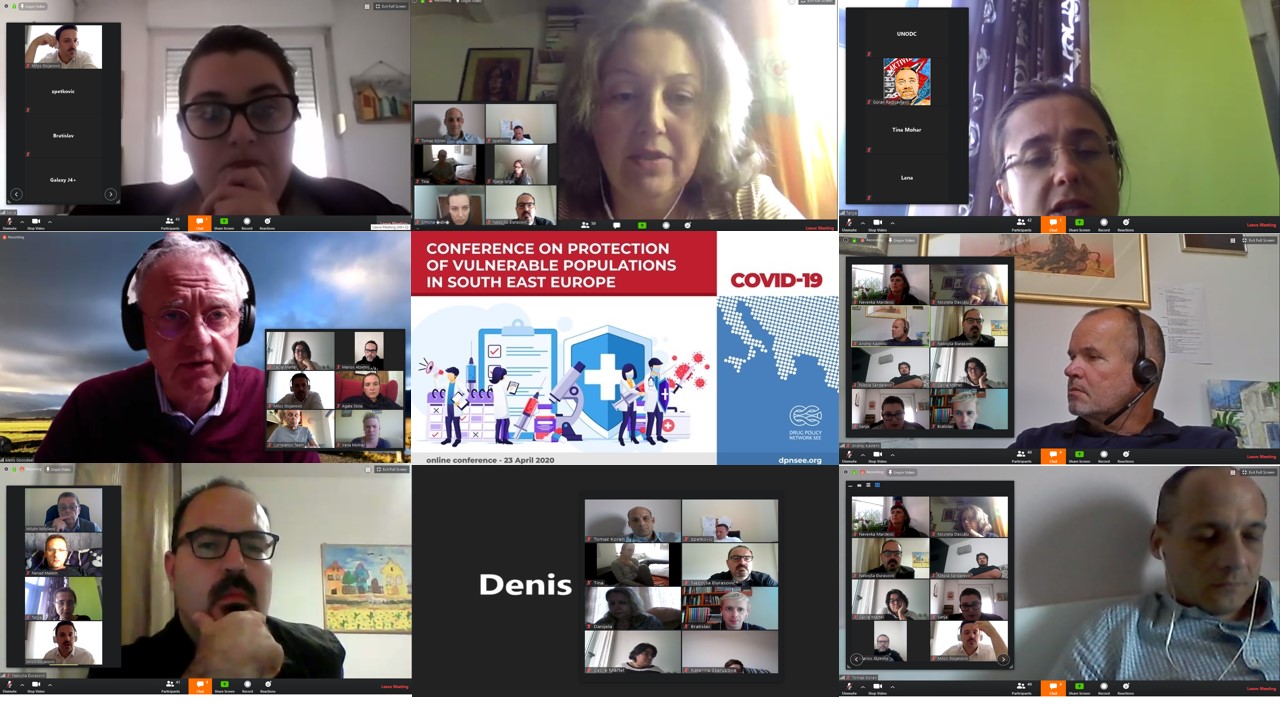
DPNSEE held today the on-line Conference on protection of vulnerable populations in South East Europe, with support of the Service for Combatting Drug Abuse at the Croatian Institute for Public Health and the United Nations Office on Drugs and Crime – UNODC Programme Office in Serbia.

More than 60 representatives of civil society organisations, national drug agencies, international organisations and agencies and donor community participated.

We heard a lot of good stories about work done in the region on supporting vulnerable populations and several interesting ideas for actions to ensure that harm reduction services are sustainable during and after the COVID’19 epidemic.


DPNSEE prepared background documents for the Conference which are available at the recent news on our website>>>.

Here are updated documents, with some fresh information from countries, and the Minutes from the Conference.

  • Overview of the situation with coronavirus COVID-19 in SEE with two annexes (available here>>> with both annexes or here>>> as a separate document):
  • Annex 1 – Information received from countries of South East Europe during conference calls (available here>>>)
  • Annex 2 – DPNSEE activities during the coronavirus outbreak (available here>>>)

Minutes from the Conference are available here>>>.

Presentation from Mr Miloš Stojanović, Regional Project Manager at UNODC, Head of Programme Office in Serbia is available here>>>.


Conference on protection of vulnerable populations in South East Europe

Spread of the coronavirus and illness officially known as COVID-19 around the world, in Europe and in the region of South East Europe has a devastating effect on general population as well as on people who use drugs and other connected vulnerable populations (homeless people, sex workers, LGBTI, MSM, people living with HIV and many others).

DPNSEE reacted early on the information about possible outbreak of the coronavirus in Europe sending a Letter to member organisations inviting them to prepare for the coronavirus outbreak with brief instructions, publishing the Public appeal to protect vulnerable groups from coronavirus COVID-19, sharing and translating instructions and advice on coronavirus and keeping contacts with our member organisations and international partners. We regularly update news from South East Europe – they are available at the News section of our website.

We held conference calls with our member organisations by countries from South East Europe last weeks. We heard a lot of good stories about their work and ideas to share.

Analysing the situation and discussing potential developments during and after the outbreak, the DPNSEE Board decided to hold the on-line Conference on protection of vulnerable populations in South East Europe. The Conference will be held with support of the Service for Combatting Drug Abuse at the Croatian Institute for Public Health and the United Nations Office on Drugs and Crime – UNODC Programme Office in Serbia.

The aim of the Conference is to contribute to ensuring the sustainability of services for key populations during and after the coronavirus epidemic. As stated in the UNODC document Suggestions about treatment, care and rehabilitation of people with drug use disorder in the context of the COVID-19 pandemic “it is important to ensure the continuity of adequate access to health and social services for people who use drugs and with drug use disorders and provide the continuum of care required as described in the International Standards for the Treatment of Drug Use Disorders (UNODC/WHO, 2020) to the best extent possible also in times of crisis”.

Besides our members and other civil society organisations from the region and wider, we invite to the Conference national drug agencies and health institutions, international organisations partners and donors.

The Conference will be held via Zoom at the following link https://us02web.zoom.us/j/86072202401 on Thursday 23 April 2020 starting at 14:00 CET (15:00 EEST). The conference would last for a maximum of two hours.

The Agenda will include two items:

  1. Overview of situation with coronavirus among vulnerable populations in South East Europe.
  2. Proposed actions to ensure sustainability of services for key populations during and after the coronavirus epidemic.

The background documents for the Conference we plan to prepare and post here in the next few days include:

  • Overview of the situation with coronavirus COVID-19 in SEE with two annexes (available here>>> with both annexes or here>>> as a separate document):
  • Annex 1 – Information received from countries of South East Europe during conference calls (available here>>>)
  • Annex 2 – DPNSEE activities during the coronavirus outbreak (available here>>>)
  • Draft list of actions and measures to ensure sustainability of services for key populations during and after the coronavirus epidemic (in progress).

In preparations for the Conference, we shall also use and refer to the documents which are also produced and promoted internationally, including those from UNODC, UNAIDS, EMCDDA and other national and international intergovernmental and civil society organisations.

We sincerely hope that you shall join us in this effort to make sure that a truly inclusive universal health coverage grounded on rights-based laws, policies and procedures is achieved by prioritizing and protecting vulnerable groups.


Crime in the Western Balkans during the coronavirus

Did organized crime groups continue with their activity at the time of Coronavirus, which trends in the criminal activities in the Western Balkans can be noticed in the first six weeks of the pandemic and which scenarios can be envisaged for the future?

Saša Đorđević

The Belgrade Centre for Security Policy published a report on criminal activities in the Western Balkans during the COVID-19 outbreak – Crime in the Western Balkans during the coronavirus – early findings. The report was prepared by their researcher Saša Đorđević.

The report states that “The region has experienced a small increase in the price of marijuana, which is still very much present on the market. The same applies to stimulant drugs” and that “People with drug and alcohol problems, persons living with HIV, those who are susceptible to stress, citizens with mental health problems, pensioners, the poor, the homeless and recently released prisoners are the biggest potential victims of crime during this pandemic crisis.”

Scenarios envisaged for the future include the one that “There will be a decline in the supply and quality of illegal drugs. The price of heroin substitutes is expected to increase. It is certain that criminal groups will find alternative ways of distributing narcotics and other illegal products in urban areas, using mobile technologies and couriers, but also corruption of law enforcement. It is possible that criminal groups will shift their manufacturing and logistics activities to smaller towns and rural areas, where they will be less visible.

With information we received from our member organisations from around the region, DPNSEE provided significant contribution to the report section that deals with Narcotics, but also general comments and proposals for recommendations.

Belgrade Centre for Security Policy (BCSP) is an independent think-tank publicly advocating human, national, regional and international security based on democracy and respect for human rights.

The report is available in English (Crime in the Western Balkans during the coronavirus – early findings) or in Serbian (Kriminal na Zapadnom Balkanu u doba korone: prva zapažanja).

Special call for grant applications for pilot activities responding to local needs arising from the COVID-19

The European Youth Foundation (EYF) is launching a special call for local or national youth organisations that are looking for funding for activities which respond to local needs arising from the COVID-19 crisis.

You can apply for the EYF pilot activity grants. Priority will be given to pilot activities that aim at demonstrating solidarity and support to all persons affected by the COVID-19 crisis, such as:
  • Reaching out to and supporting particularly vulnerable groups of people, including homeless, refugees and asylum-seekers, people with disabilities, people living in isolation or in remote communities;
  • Support to health, social and educational services;
  • Education and awareness-raising of the importance of human rights in responses to COVID-19 crisis.

All pilot activities must respect the sanitary and safety measures put in place by the competent authorities at national and/or local level. Further, applicant youth organisations are strongly encouraged to co-ordinate their activities with the competent authorities and to indicate such in their project proposal.

The maximum EYF grant to a pilot activity is €10 000. The next cut-off date will be 10 May, but COVID-19 related applications may be submitted throughout 2020. Subsequent cut-off dates will be defined later in 2020, and include June and September, to allow for the processing of applications and decisions on grants.

Youth organisations can submit applications only if they are registered with the EYF. The instructions and criteria for registration can be found here>>>.

Information on the procedure and criteria for application can be found on the EYF website following this link>>>.

Mini-European Web Survey on Drugs

In order to investigate and rapidly document the current impact of the COVID-19 epidemics and national responses in the EU Member States on changes in patterns of drug use, harms and service provision, the European Monitoring Centre for Drugs and Drug Addiction (EMCDDA) is carrying out a study using an adapted version of the trendspotter methodology across EU Member States, of which this survey on Impact of COVID-19 on patterns of drug use, harms and drug services in the European Union forms a part. The Mini European Web Survey on Drugs: COVID-19 is part of this snapshot and is being conducted across Europe. The aim is to gather information about how patterns of drug use may have changed in Europe due to COVID-19.
Since the outbreak of COVID-19 across Europe and subsequent national responses to contain and mitigate the epidemic (self-isolation, quarantine, confinement, lockdowns), information has emerged about unprecedented challenges for services providing care to people who use drugs in the community and in prisons. Anecdotal information also indicates that there may have be changes in drug use patterns and in how people are obtaining their drugs. Understanding and sharing information on the consequences of COVID-19 and national response measures on harms deriving from the lack of access to care and how services have adapted as a response may help services improve their responses.

The information collected is entirely confidential and will be kept safely. The questionnaire is also anonymous – although there are a few broad questions about general situation to help understand how different groups of people who use drugs have been affected by the COVID-19 restrictions and how services have responded in different parts of Europe. This will help the sharing of good practice and improved preparedness in the future.

To contribute to the survey, follow this link>>>

COVID-19 crisis’ Impact on PLHIV and on Communities Most Affected by HIV

Concerns have been raised about the various implications the COVID-19 pandemic can have for people living with HIV and different communities affected by HIV, as well as for healthcare systems. There are also opportunities and solutions to be found. The European AIDS Treatment Group, as a network of people living with and affected by HIV and partners in Europe and Central Asia, supports community reporting and exchange between members and partners to support mutual learning and advocacy at local or European levels.

This rapid assessment aims to document in a structured manner the perceptions of people living with and affected by HIV and that of organisations providing services to affected communities about the way in which COVID-19 impacts their health, well-being and access to HIV related prevention, treatment and care. This assessment has its limitations and biases (little time to develop the tool, questionnaire only available online and only in English, limited time the survey was open). Nonetheless, this rapid assessment provides a snapshot of information, concerns and solutions shared by respondents in several countries during the week of 27 March to 3 April 2020.

Respondents include those from Romania, Albania, Slovenia and Greece.

The rapid assessment is available following this link>>>


Social Security Protocol for Civil Society

CIVICUS – a global alliance of civil society organisations and activists dedicated to strengthening citizen action and civil society throughout the world, published “Protecting our co-workers during COVID-19: A Social Security Protocol for Civil Society”. It includes a set of social protection measures that civil society organisations can consider to protect our colleagues from the adverse economic and psychosocial consequences of the pandemic.

Based on the International Labours Organisation’s policy framework to fight coronavirus, the six-point protocol provides a shared template for civil society groups to deliberate context-specific measures and adopt feasible actions in a time-bound and transparent manner. The proposed measures are:

  1. Systems to ensure physical distancing and other precautions.
  2. Support for COVID-19 testing and related treatment.
  3. Protection of jobs and pay across the COVID-19 lockdown and escalation period.
  4. Flexibility and support for home and care related responsibilities.
  5. Extending our community of care to our collaborators and constituencies.
  6. Acting in solidarity with workers and other vulnerable communities.

DPNSEE have signed the Protocol.

Should your organisation like to do the same, find the Protocol following this link>>>


AIDS 2020 goes virtual

In light of the COVID-19 pandemic, the 23rd International AIDS Conference (AIDS 2020), to be held on 6 – 10 July 2020, will become the first virtual edition of the International AIDS Conference because the health and safeguarding of our community is our highest priority.

AIDS 2020: Virtual will enable delegates to access and engage with the latest HIV science, advocacy and knowledge traditionally presented at the conference. It will be a combination of virtual sessions and community networking, including exhibitions, workshops, the Global Village, satellites and pre-conferences, that will reach audiences around the world.

The decision was informed by advice from the World Health Organization, UNAIDS, leading global and local health authorities and people living with HIV around the globe. In particular, organisers are acutely aware that there is not yet sufficient data on whether people living with HIV are more susceptible to COVID-19 or more likely to develop severe disease. Therefore, there is a special obligation to reduce any potential risk to the HIV community.

The theme of this year’s conference is Resilience and there is no better word to describe the HIV community and its ability to come together in a shared commitment to the global HIV response.

Registered delegates will be contacted directly in due course with further information on the new, reduced pricing structure. Details about the virtual programme will be shared in the coming weeks.

Follow the conference website for more information.