At the meeting held on 22 June, the DPNSEE Board decided to restructure the Office. To improve efficiency of its work, besides the Executive Director the Staff will now include:
• Financial and Administrative Officer expected to work 80% of working time
• Communications officer, a contract based position or consultancy contract, with a total of six working days a month
The Staff members will be engaged for the period September – December 2018, with a potential to continue working in the next year(s).
If you are interested to join a small and aupportive team of a growing network working for a cause, have a look at the Calls bellow and send your CV indicating the work experience and qualifications and a description of the motives for applying by 27 August, at 12:00 CET.
DPNSEE encourages people who use drugs and members of other vulnerable populations to apply for jobs.
The Project Planning Meeting of the Budget Advocacy and Monitoring in countries of South East Europe project, supported by the Open Society Foundations and the Eurasian Harm Reduction Association, was held on Friday 3 August 2018 in the DPNSEE Office in Belgrade. The aim of the meeting is to gain mutual understanding and full ownership of the project and operationalize the plan of actions.
Organisation of training, national in all three participating countries Bosnia Herzegovina, Montenegro and Serbia, and regional was most discussed. Profile and recruitment of consultancy teams, preparing national programs of actions and management of the budget were at the table too.
Dates and venues for the trainings are as follows:
The regional training for all three national Consultancy teams will be held from 3 to 5 September in Sarajevo, Bosnia Herzegovina
The training in Bosnia Herzegovina will be held from 5 to 7 September in Sarajevo
The training in Serbia will be held from 24 to 28 September
The training in Montenegro will be held from 1 to 5 October in Podgorica
In December 2017, The Global Fund to Fight AIDS, Tuberculosis and Malaria called for proposals from qualified organizations to provide programming for the HIV strategic priority area “Sustainability of services for key populations in Eastern Europe and Central Asia region” under the Multicountry catalytic funding modality for the 2017-2019 Allocation Period. Five proposals were submitted. The Global Fund announded at the AIDS 2018 Conference last week that all of them were not of excellent quality and that only one will be supported. Here is the information about which one was awarded.
New levers of change in Eastern Europe and Central Asia: Global Fund awarded multi-country project to the Alliance led regional consortium
On July 31, 2018, the Global Fund announced its decision on the approval HIV multi-country project ‘Sustainability of services for key populations in EECA region’ submitted by consortium of regional organizations from Eastern Europe and Central Asia (EECA) – Alliance for Public Health, All-Ukrainian Network of PLWH 100% Life, Central Asian PLWHA Association and Eurasian Key Populations Health Network (EKHN), together with technical partners and TB People. The proposal incorporated contributions from Belarus, Georgia, Moldova, Kazakhstan, Kyrgyzstan, Russian Federation, Tajikistan, Uzbekistan and Ukraine.
The Global Fund informed that the application from Alliance-led regional consortium was approved in full amount with the total budget over $ 10.5 million for three years (2019-2021).
The main objective of this project is to ensure the sustainability of services for key populations and to substantially improve the HIV cascade in the key countries of the EECA region.
“EECA is nearly the only region globally with rising HIV infections. We have very ambitious targets: to stop this dangerous trend and to make services for key populations accessible and sustainable in our region. We are ready to cooperate and join efforts with all partners to make national funding for key populations a reality!’, – stated Andriy Klepikov, Executive Director of Alliance for Public Health.
“Nine countries with high levels of HIV in the region will be able to use technologies and solutions that have already proven effective. We, as the largest patient organization, are ready to partner with our colleagues to provide access to treatment, services and resources for all key populations and patients,” – said Dmitry Sherembey, Head of Coordination Council, 100% Life.
Although the main focus of the project is HIV, the consortium of regional organizations will be working closely with the multi-country TB project which will be implemented by a consortium led by PAS Center (Moldova) in 2019-2021 with the support of the Global Fund.
This is the joint victory of national, regional and international partners and the consortium is looking forward to implementing the work together.
DPNSEE congratulates the Consortium and wishes them success in implementing the project.
This article of the News will be updated daily during the Conference
More than 15.000 researchers, activists and policy makers from more than 160 countries gathered in Amsterdam for the 22nd International AIDS Conference (AIDS 2018). The International AIDS Conference is the largest conference on any global health issue in the world. First convened during the peak of the AIDS epidemic in 1985, it continues to provide a unique forum for the intersection of science, advocacy, and human rights. Each conference is an opportunity to strengthen policies and programmes that ensure an evidence-based response to the epidemic.
Mayor of Amsterdam Femke Halsema opening the Global Village
The theme of AIDS 2018 is “Breaking Barriers, Building Bridges”, drawing attention to the need of rights-based approaches to more effectively reach key populations, including in Eastern Europe and Central Asia and the North-African/Middle Eastern regions where epidemics are growing.
Six member organisations and DPNSEE have representatives at the Conference.
A specific warm-up of the Conference was the official opening of the AIDS 2018 Global Village by the Mayor of Amsterdam Femke Halsema and Elizabeth Taylor grandchildren Quinn Tivey, Laela Wilding and Naomi Wilding on Sunday 22 July.
Daily highlights from the pre-conference events on 21 and 22 July is available following this link>>>
***
Monday 23 July, the first formal working day of the Conference, was already full of activities. Representatives of civil society organisations from South East Europe held a consultative meeting with the Open Society Harm reduction Programme representatives. It was a good opportunity to refer to some important issues, including prices of medicines, regional multi-country project for the Global Fund and sustainability.
At the session “Harm reduction for people who inject drugs in Europe: Findings from European Joint Action HA-REACT”, the EU Health Programme 2014-2020 addressed gaps in the prevention of HIV and other co-infections in the European Union. This session focused on harm reduction services in Europe for PWID, presenting new findings and good practices from this major European project including tailored low threshold services for women who use drugs, harm reduction for prisoners and mobile unit outreach work. Presentations from the session are available following this link>>>>
In the evening, a formal opening session of the Conference was held. It was a moving and empowering, filled with emotional moments remembering those who we have lost and celebrating those who are furthering the fight against AIDS, with a special performance by the Dutch National Ballet, a keynote address by Conchita, a special tribute to MH17 and many more powerful moments.
The grandchildren of Elizabeth Taylor talked about returning Amsterdam where it all started in 1992 and how her work continues today with The Elizabeth Taylor Human Rights Award winner, Allan Achesa Maleche. The famous quote from Dame Elizabeth Taylor’s famous speech at the 1992 AIDS Conference, was the theme of last night’s opening ceremony – “The fight against AIDS is not and must never be a fight against other people, it’s a fight about human beings against a virus.”
You can watch the recording of the opening session
Tuesday 24 July morning started with a plenary session with celebrities of the Conference. The session focused on understanding the inequity in HIV response and stressed to need to focus on specific populations who are left out. The message that risk of HIV is not evenly distributed and most infections are emerging from unmet prevention and treatment needs was clear.
The highlight was the speech of Charlize Theron, a famous actress who is founder of the Charlize Theron Africa Outreach Project in South Africa. Her native country. She reminded of her Dutch origin and all the colonial approach which brought so much suffering to African people. She invited to fighting prejudices and emphasised excellent activism of young Africans she observed while working on fighting HIV. You can see the Charlize Theron’s speech at AIDS 2018 Youtube channel below
Special presentation which included Sir Elton John and HRH The Duke of Sussex announced that a group of major HIV/AIDS donors, NGOs, and pharmaceutical companies have joined forces into The MenStar coalition to launch a $1.2 billion coalition to expand the diagnosis and treatment of HIV infections among men, who are currently less likely to be accessing these services.
A leadership workshop “It is OUR money!: Effective community advocacy to insure domestic resources for sustainable HIV services” was designed based on budget advocacy experience in EECA countries and utilizes knowledge from health financing and public financing fields to help community and civil society leaders to learn how to do budget advocacy work and formulate successful budget advocacy strategies. Elizabeta Božinovska from HERA, Macedonia, presented results of the budget advocacy and monitoring efforts that resulted in country taking over financing harm reduction services.
The Robert Car civil society Networks Fund celebrated and showcased their work and impact of civil society and community led networks in the HIV response at the session “From Invisibility to Indivisibility”. The Fund is the first international pooled funding mechanism that specifically aims to strengthen global and regional HIV civil society and community networks across the world. This focus is in recognition of networks’ critical value and contribution to better health, inclusion and social wellbeing of inadequately served populations (ISPs), given their unique reach into and impact at community level. The news is that the Fund will, though the Request For Proposals for 2019-2021, also support newly applied networks!
***
One of the most interesting sessions on Wednesday 25 July was “Drugs, drug policy, harm reduction: A reality check”, co-chaired by Ruth Dreifuss, Former President of Switzerland and Chair of the Global Commission on Drug Policy and John-Peter Kools from the Trimbos Institute, Netherlands, with Julia Buxton, Central European University, Hungary, Daniel Joloy, Amnesty International, Daniel Wolfe, Open Society Foundations, Niamh Eastwood, Release, United Kingdom and Judy Chang, International Network of People Who Use Drugs (INPUD). The session made a powerful case for moving away from drug prohibition and abstinence as the key outcome of interest. Examples from the Czech Republic, Portugal, and other 25 countries experimenting decriminalization show that if we are to reach our 2030 goals we need to end mass incarceration, mass killings, and mass criminalization of drug use and drug possession. Most importantly, we are not going to do it without working with people who use drugs. All panellist argued that a combination of factors contributes to this massive failure. The failed war on drugs has been unfolding into wars on people in the Philippines, most of Latin American, Asia and the US; the over reliance on biotechnologies, biometrics, e.g. PreP, increase costs and shift people away from the basic message of harm reduction, that is to focus on “people needs, not health interventions” an emphasised the role of communities as key to getting back on track. A video recording and all presentations (some very effective) are available following this link>>>
The session “Civil society under threat: How can HIV advocates resist the impact? Conservative populism and social exclusion of civil society” has indicated that repression of civil society is rising. In 2012-2015, more than 120 laws restricting civil rights were introduced or proposed in 60 countries. Governments are implementing legal, administrative and other measures restricting operations of non-governmental organizations, particularly those rooted in marginalized communities disproportionately affected by HIV. Repression tools include burdensome registration requirements, restrictions on basic freedoms (including peaceful assembly and online expression), physical attacks and imprisonment. Péter Sárosi, from the Rights Reporter Foundation, Hungary and Ivan Varentsov, from the Eurasian Harm Reduction Association were among panellists. Video from this interesting session is available following this link>>>
The session “Why do we fail in responding to the epidemic among people who inject drugs?” brought together science, law enforcement and community in a panel that tried to answer a recurring question: why we are failing to respond to skyrocketing epidemics among PWID, particularly in Eastern Europe, where the lack of appropriate responses is accounting for unprecedented levels of HIV transmission? Presentations and video from the session are available following this link>>>
***
You can follow all of the #AIDS2018 action throughout the week:
Live streaming: Watch the live stream of the opening and closing ceremonies, the plenary sessions, special sessions and official press conferences http://www.aids2018.org/Live
Facebook: AIDS 2018 Live! Tune into live sessions featuring conversations with experts, advocates and news makers from the conference https://manychat.com/l1/HIVgov
Instagram: Follow @aids_conference to see snapshots from around the conference, with a behind-the-scenes look via Instagram take-overs from special guests https://www.instagram.com/aids_conference/
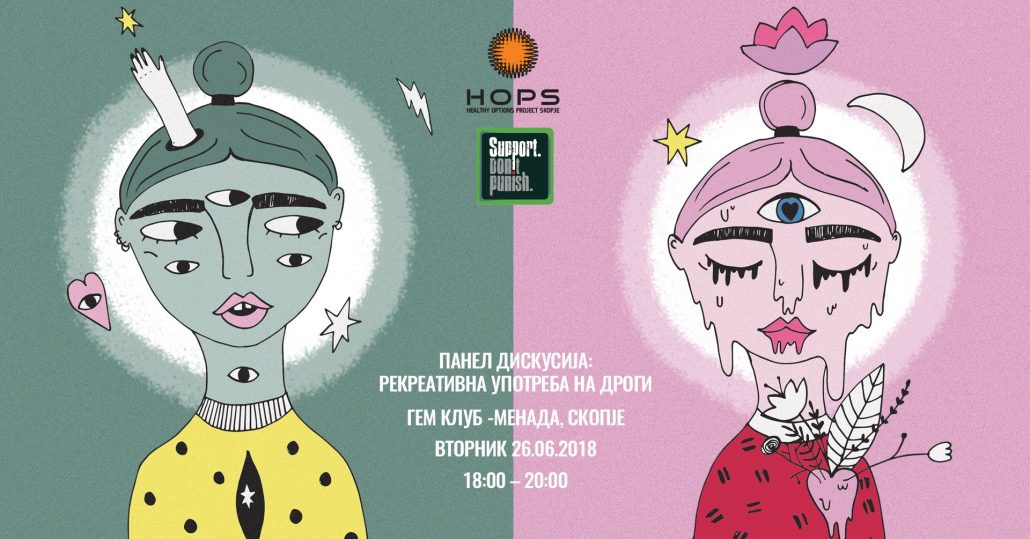
Several activities took place as part of this year’s “Support. Don’t Punish” campaign in Macedonia, among which central was a Public debate on recreational drug use and harm reduction.
In preparation for the debate, informational flyers were prepared; containing information on most commonly used drugs in Macedonia in recreational settings, as well as advises on harm reduction and rights. An event page was created and promoted on Facebook, and the event was announced via the media.
The Public debate took place on 26 June 2018. Dr. Davor Smilanov (HOPS’s collaborator) moderated the debate, while the discussion panel was composed of Dr. Darko Kostovski (psychiatrist), Ivana Dragshich (sociologist and activist) and Dragana Drndarevska (lawyer and activist). Around 50 people attended the event. They had the chance to purchase t-shirts and bags prepared by the HOPS’s creative workshop, the funds from which were donated back to the workshop towards its sustainability. In addition, the debate was streamed live (and later posted) on HOPS’s page, reaching about 1.200 views (https://www.facebook.com/hops.org/videos/1259588700811262/). The conclusions from the debate were shared via HOPS’s communication channels, with special focus on laws and practices that criminalize drug use and their adverse effect on individual rights, health and other aspects of living.
The campaign concluded during D-Fest (music festival that took place 6-8 July 2018), where HOPS’s team had an informational stand, organized educational workshops and hosted creative workshops, all with the purpose to inform attendants about effects of different drugs, strategies for harm reduction, as well as individual rights.
The DPNSEE Board held a regular June meeting by Skype. The meeting was scheduled for 12 June, when the Board went through the half of the agenda. The meeting continued on 22 June.
The Board adopted the minutes from the meeting held on 1 – 2 March 2018 in Skopje and the electronic meeting held on 18 May. The Board decided about dates for events in 2018.
The Board will send a letter to Correlation to express interest in participating in the process of establishing the European Harm Reduction Network. DPNSEE can be a focal point for South East Europe and propose a future Board member for which we shall wait for opening of a call for candidatures.
The Board was informed about the discussions at the meeting of the EU project partners on the future of the EU funded project and the process of designing and planning the project on budget advocacy and monitoring. Also, an information about the initial discussion with the Open Society Foundation on the programme on the quality of services was presented.
The Board supported the membership application of the Alliance of Non Governmental Organisations for Drugs and Addictions, from Slovenia and proposes to the General Assembly to grant it an ordinary membership status. The Board also proposes that the General Assembly grants associate membership to the Association “Duga” from Šabac, Serbia.
The Board was informed that, following the Board decision, Staff sent reminders for unpaid membership fee for 2016. Member organisations Aliat and Proi paid the unpaid fees, while there were no reply from Re Generacija. Respecting the provisions of the Article 11 of the DPNSEE Statute, the Board proposes to the General Assembly, which is only eligible to decide about membership status, to delete the ordinary membership of Re Generacija and grant it the status of associate member.
The Board adopted the proposed draft Terms of reference of the DPNSEE Scientific Committee. An open call for proposals for membership in the Scientific Committee shall be sent to all member organisations at the end of August 2018, with deadline for applications set to mid-September 2018.
The Board discussed the situation with the Office and decided that Milutin Milošević will continue as the Executive Director and that a call for Financial and administrative officer with full working time in the Office and a Communications officer with 50% working time will be openned.
After a year without the campaign, the Initiative for Health Foundation added Sofia to the list of participating cities in 2018.
The Foundation engaged a professional reporter to explain the content of the campaign, its story around the world and in Bulgaria. The article was published in the web-site and FB of Initiative for Health Foundation (where the article reached primarily 531 persons), in the web-portal of the Bulgarian non-governmental organizations NGOBG and in 4 online media.
A photo-frame for profile pictures was developed and distributed in Facebook for people who would support the campaign.
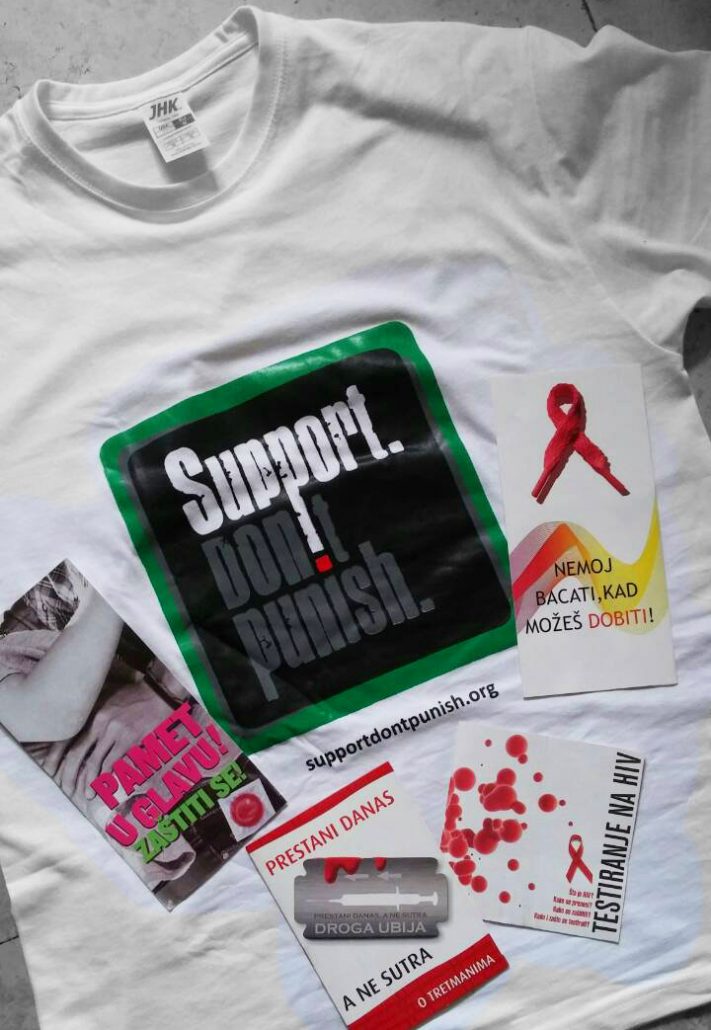
In addition, 80 t-shirts were produced with the campaign logo and were distributed during 4 events of Initiative for Health Foundation in the period 31 May – 26 June 2018: one public discussion, one networking seminar and two trainings.
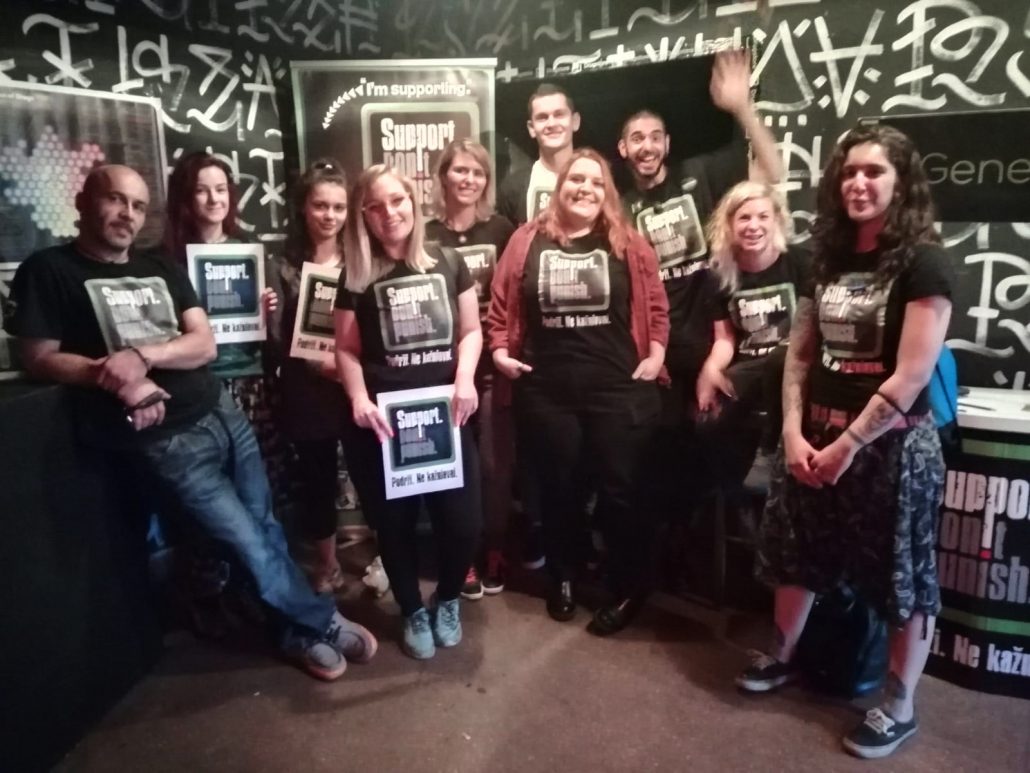
On Tuesday, 26th July 2018, the International Day against Drug Abuse and Illicit Trafficking, the NGO ReGeneration, in cooperation with the Belgrade night club Drugstore, organized an event as part of the Support. Don’t Punish campaign. The event, starting at 8 PM, was held in the Drugstore night club in Belgrade; the stand was placed in the lobby, next to the door leading to the main area, and opposite it, in front of the coat check, was displayed new informative material on the most common psychoactive substances and acute health issues the consumption there of could result in. A large poster of the campaign, in front of which visitors could, if they so wished, be photographed by members of ReGeneration’s with the Support. Don’t Punish logo as an act of support, was also placed in the lobby. Also, those who wished to could complete a short questionnaire regarding the usage of (new) psychoactive substances prepared by our team.
The visitors could then enter the main club area, where our guest Marko Milosavljević was the DJ support. To the backdrop of Marko’s music, the rest of the event passed in informal socialization and discussion. In casual conversation, the guests and visitors from various countries and of various educational profiles – anthropologists, healthcare professionals, psychologists, artist, etc. – touched upon many issues regarding the consumption of PAS and NPAS among the youth not just in Serbia and the region but globally as well, such as legislature, public policy, harm reduction strategies and public and media discourse on (N)PAS consumption. ReGeneration is determined to continue the tradition of organizing different events on the International Day against Drug Abuse and Illicit Trafficking with the goal of raising awareness and informing the general public.
Support Don’t Punish objectives were also promoted on the Pride Parade in Belgrade, by the Re Generation and YODA members. As Pride Parade had the topic of HIV prevention, we though it is important to support members of other vulnerable populations in fight against discrimination and stigmatization of all of us.
Before and after the event NGO Re Generation representatives were also present in media presented the goals of the Support Don’t Punish Global campaign to general public in addition to campaign that was recent initiated, as an answer to death of three young persons, related to the use of psychoactive substances, that inspired Re Generation to even more and bit aggressive advocate for the harm reduction programs in the recreational settings. #DAZNAMŠTARADIM is the campaign aiming to support and push for the implementation of nightlife outreach programs as a necessity.
The Support. Don’t Punish campaign in Tuzla, Bosnia Herzegovina started on 11 June 2018 with showing film “I want to wake up” three times for the population of high school students and three times for the population of students. The goal was to point out the problem of education of this population and reduce stigma and discrimination against drug users. In this way, the message and the global goals of the campaign was promoted and shared among young people.
Association Margina had an ambitious plan to hold a public debate and press conference “CANTONAL INSTITUTION FOR DISEASES – Why do we not have it?” as introductory event to the entire day of action on 26th of June where Bosnia and Herzegovina National Drug Strategy 2018 – 2023, Policy to reduce drug use damage in the Federation of Bosnia Herzegovina, Decisions of the Government and the Tuzla Canton Assembly on the establishment of the “Institute for Addiction of the Tuzla Canton” should have been presented. Unfortunately, this activity was cancelled, because just before the start of the entire campaign, health workers started striking, both to fight for their rights, but also due to poor conditions for patients. The strike escalated in a way that 1.370 doctors and more than 4.000 medical technicians locked in their dismissals.
Regardless of the cancelled public debate, Margina have drawn good lessons from this process, as a model of pressure and struggle for the human rights of professionals and patients in whose interests they work. In the upcoming period they plan a meeting or a series of them with the Health Workers Union, in order to try to organize joint activities to improve the quality of services for drug users.
Still, a street action was organised in the city of Tuzla, including disseminating promotional materials, meeting people and spreading information about the campaign and work of the association.


 Call for the Financial and Administrative Officer