DPNSEE participation on Rational Drug Regulations Conference

From 4 to 6 October in Brno, Czech Republic, the Conference on Rational Drug Regulation was held, organised by A.N.O. – Asociace nestatnichne ziskovych organizaci a Spolecnost Podaneruce o.p.s

The conference had an aim to start the dialogue and question social, political and professional attitudes that are going through phase of change that we can witness. At the states level we see examples of changing policies regarding cannabis for example, but on the other hand we still see policymakers practice the so call war on drugs. Rationality of Drug Regulations Conference aimed to open space for the dialogue regarding how these trends are reflecting on the local level? How are the local governments, relevant activist groups or organisations, activist groups, police forces, schools dealing with this changing situations? The Conference aimed primarily at professionals; however, it was also open to members of public interested in the topics.

Within the panel “Harm reduction: Between professionalization and activism”, DPNSEE Staff member Irena Molnar was representing the cases of SEE, and from this point of view she was presenting case study “Serbia’s Drug Policy Crossroad – Will EU accession period bring more balanced approach to (recreational) drug use?“

The conference also discussed topics on: How are these trends reflected at the local level? How are they advocated, explained and interpreted by the general public? What direct experience do the specific villages, towns, neighbourhoods, and streets have with these? How are the local governments, relevant organizations, activist groups, police forces, schools or helping network services dealing with the changing situation of the drug regulation?

More about conference program and keynote speakers you can find on the conference website. Also, check the book of abstracts

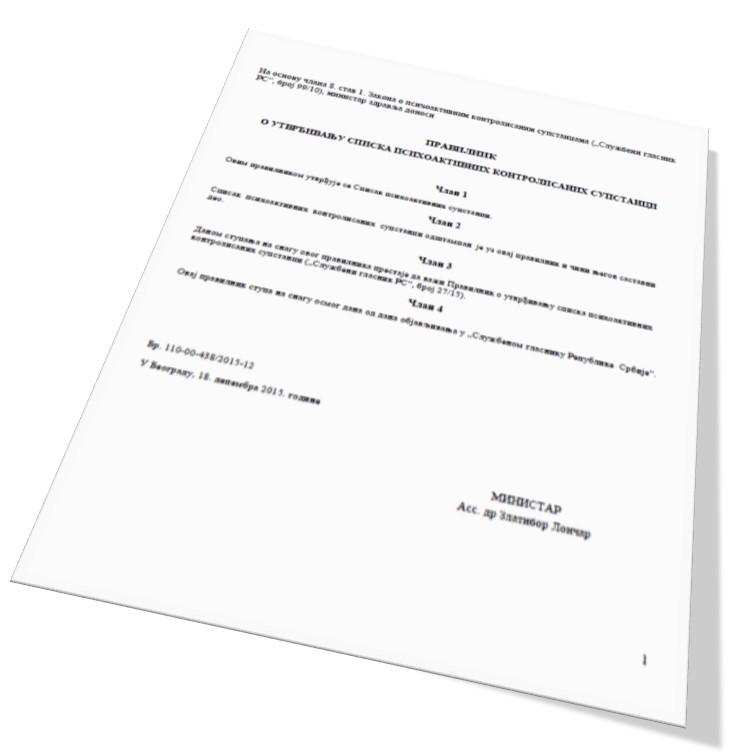
Long way to make good changes in the Law

Ministry of Health of Serbia proposed changes to the Law on psychoactive controlled substances at the end of 2016. Very limited proposal and the public debate which was organised during 4 weeks of festive days caused serious concern among civil society organisations in Serbia. DPNSEE with two member organisations Prevent and Re Generacija, along with three other partner organisations, made large number of comments and proposals to improve the draft.

Unfortunately, there were no reply from the Ministry for more than 9 months. Finally, with the support of the Office for Cooperation with Civil Society, a meeting was organised on 4 October to discuss our contribution. Representatives from the Ministry of Health, Office for Cooperation with Civil Society, Office for combating drug abuse and Ministry of Interior met with the aim to present civil society organisations comments and proposals and exchange about which of them should be incorporated into the next version of the draft.

Although we were prepared for qualified discussion about our proposals, it turned out that the Working group in the Ministry of Health already prepared the next draft and that some of our proposals were accepted. Despite the requests to specify which proposals were accepted and which not and why, the representatives of the Ministry remained on the position that it will be possible only when this new version will be sent for the next round of consultations.

The meeting had a limited success because we presented comprehensive and qualified approach to dealing with legislation and stayed on our positions regarding very important issues related to drugs: need to ensure involvement of civil society organisations in all issues related to drug use, wider set of services of the early warning system that is to be established (including field work and consulting), right to bring samples of substances for checking, wider distribution of naloxone around the country, use of language that will not stigmatise people who use drugs, respecting the right to information and protection of sensitive information, better coordination of all the stakeholders, especially reporting about drugs, etc. The proposed amendments to the Law still have to pass a few levels to come to the Parliament and we are ready to keep advocating for a better Law.

International Narcotics Control Strategy Report

The Department of State’s International Narcotics Control Strategy Report (INCSR) is an annual report by the US Department of State to Congress prepared in accordance with the Foreign Assistance Act. The report for 2016 was published in March this year.

The INCSR is the United States Government’s country-by-country two volume report that describes the efforts to attack all aspects of the international drug trade, chemical control, money laundering and financial crimes. It describes the efforts of key countries to attack all aspects of the international drug trade in Calendar Year 2016. Volume I covers drug and chemical control activities. Volume II covers money laundering and financial crimes.

INSCR is a valuable tool when assessing the risks relating to geography and jurisdiction. It highlights the most significant steps countries and jurisdictions categorized as “Major Money Laundering Countries”, defined by statute as one “whose financial institutions engage in currency transactions involving significant amounts of proceeds from international narcotics trafficking”. Countries of South East Europe which were categorise as such in 2016 are Albania, Bosnia and Herzegovina, Serbia and Turkey.

The report also includes country files for most of the SEE countries.

The report may be downloaded from the US Department of State website following this LINK>>>

Multi-stakeholder workshop on UN Convention against Corruption in Southeast Europe

UNODC hosted the first multi-stakeholder workshop on the United Nations Convention against Corruption and its Review Mechanism in Sarajevo, Bosnia and Herzegovina, from 25 to 29 September 2017. As the first such workshop held in Southeast Europe, the event aimed to develop capacities of around 60 participants across the region to contribute to the implementation of the Convention and its Review Mechanism.

The UN Convention against Corruption, ratified by 182 States, is the only legally binding, universal, anti-corruption instrument. Its far-reaching approach and the mandatory character of provisions make it a unique tool for developing a comprehensive response to global corruption issues.

The Convention covers five main areas: preventive measures, criminalization and law enforcement, international cooperation, asset recovery, and technical assistance and information exchange. The Convention covers many different forms of corruption, such as bribery, trading in influence, abuse of functions, and various acts of corruption in the private sector.

At the first review cycle, approximately 85 per cent of Governments involved civil society organizations in their country visits, building momentum to uphold their treaty obligations. The workshop, in this regard, reiterated the importance of this practice during the second review cycle, especially in the Southeast Europe region. It also aimed to promote collaboration between all relevant stakeholders.

Supported by the Austrian Development Agency through the Regional Anti-Corruption Initiative, and by the European Bank for Reconstruction and Development, the training informed participants about the methodology and tools for country reviews and build their capacity to reproduce workshop sessions at the national and regional levels. Participants engaged in a constructive dialogue by sharing their experiences, lessons learned and good practices, as well as undertaking practical exercises.

Milutin Milošević, the DPNSEE Executive Director, and Sanja Šišović CAZAS, Montenegro, participated in the workshop. That allowed them to gain a good insight in the Convention and opportunities to join the review process.

Treatment Systems in Prisons in Eastern and Southeastern Europe

Pompidou Group – Council of Europe Co-operation Group to Combat Drug Abuse and Illicit Trafficking in Drugs, published a new publication “Drug Treatment Systems in Prisons in Eastern and Southeastern Europe”. The publication sheds light into the situation of drug users among criminal justice populations and corresponding health care responses in ten countries in Eastern and Southeastern Europe: Albania, Bosnia-Herzegovina, Georgia, Kosovo*, Macedonia, Moldova, Montenegro, Russia, Serbia, and Ukraine.

Prisons differ across different countries, as do prisoner populations. In some of the countries in the study there is an almost complete unavailability of effective drug dependence treatment (e.g. Opiate Agonist Treatment), or the potential of these treatment has not been exploited yet to its full. But also models of good practice exist in a few of the researched countries.

The publication is a product of the Pompidou Group of the Council of Europe project “Improving Drug Treatment Systems in prisons” which was financed by Luxembourg.

DPNSEE Chairperson Tijana Žegura and Secretary of the Board Denis Dedajić contributed to the publication.

Those interested in downloading the publication should follow this LINK>>>

Move. Link. Engage.

The Belgrade Open School, together with the Office for Cooperation with Civil Society of Government of Serbia, organized the Third Annual Regional Conference ’’Move. Link. Engage – Rethinking Europe and Western Balkans’, on 18th and 19th of September in Belgrade. The Conference was supported by ’Europe for Citizens’ Program and Kingdom of Sweden. The goal of the Conference was to promote and encourage regional approach in solving shared problems and better cooperation among citizens and civil society in the European Integration Process.

At the main panel of the Conference, titled ’Western Balkans in Motion: Berlin Process Aftermath’, prominent speakers and participants stressed out the importance of the Berlin Process, which is recognized through shifting focus towards economic and social questions and contribution to European Integration Process of all states in the region. Participants of the session dedicated to the Civil Society Participation in European Integration Process came to the conclusion that civil society is the bridge between decision makers and the citizens, and that it is important to build alliances founded in European values and closely watch and follow the decisions that authorities make on behalf of citizens. Civil society organizations agreed that there would be no progress in the European Integration process without strong institutions and common values, and pointed out that European Integration Process should be founded in citizens’ participation in developing public policies, transparency and accountability.

During the conference, a regional workshop was organized, dedicated to project preparation within ’Europe for Citizens’ Program, as well as official diploma awarding ceremony for 24th generation of students of the ’Future studies’ Program of Belgrade Open School.

The Conference gathered more than 200 participants, numerous representatives of organizations from Serbia and the region, representatives of institutions and foundations, as well as representatives of the media, researches, activists and students. Milutin Milošević, the Executive Director, represented DPNSEE at the conference. That was a good opportunity to meet with peers from the civil society sector and representatives of authorities.

Support to the EHRN Steering Committee and Secretariat

The Drug Policy Network South East Europe was informed about problems in the Eurasian Harm Reduction Network that resulted in EHRN Secretariat staff quitting the organization and the Steering Committee resigning and creation of a new structure: the Eurasian Harm Reduction Association.

Strongly supporting our colleagues from the EHRN Steering Committee and Secretariat, DPNSEE sent a letter which you can find bellow.


Memory Recollection, Time for Action

Since 2001 31st September has been marked around the World as the International Overdose Awareness Day in order to raise public awareness of the most risky outcome of the use of psychoactive substances and gave the meaning to deceased overdoses. Serbia was on the world map of countries that marked this day in 2017 under the slogan “Memory Recollection, Time for Action”.

Overdoses with the deadly outcome due to the use of drugs, alcohol and uncontrolled use of medicines are on the rise, especially among young people. Drug users, one of the most marginalized groups in our society, do not have to be condemned to death by overdosing.

In the city of Pančevo, organisation Nova+ organised street action, to join the world network of cities where this day is marked by burning candles for the deceased and sharing information and educational materials regarding prevention of overdose and also to raise awareness of this problem in the society.

Street action in Pančevo

The marking of the day continued in with the open talk in the Apollo Hall, where professionals were discussing the problematizing this this issue in relation to Serbia through an open talk. Invited speakers were Nenad Živković writer and journalist, moderator, Osmah Hamzagić representing the Public Health Institute Pančevo, Aleksandar Žugić from NGO Izlazak, Irena Molnar in the name of the Drug Policy Network South East Europe and host Branislav Princip from Nova+ organisation.

Conclusion of almost two hours of talk was as expected: society has a problem with overdoses – Serbia is not excluded. The first step in preventing overdose has to be raising awareness of the issue and recognising it as a public health problem that has social consequences. Recognition of symptoms, proper treatment in this case and the latest pharmacological preparations for the prevention of fatal outcome, which are recommended around the world, should become common practice in Serbia too.

Open talk in the Apollo Hall

Drug problem and its influence on children and youth

Representatives of the Drug Policy Network South East Europe, including Nebojša Đurasović, member of the DPNSEE Board, Irena Molnar, DPNSEE Communication officer and office manager and Milutin Milošević, Executive director, met with Ms Vesna Dejanović, Project Officer Child Protection at the UNICEF Belgrade Office. The meeting was held on 11 August 2017.

The motive for the meeting was decision of the Novi Sad authorities to supply free drug tests to parents in local schools (last two classes of elementary and all secondary schools) as from the start of the new school year. DPNSEE sent a letter to the UNICEF Representative in the Republic of Serbia stating that we find this action is jeopardizing children rights and very problematic for several reasons, including:

  • Drug testing in schools is not needed and effective; even it is forbidden in some EU countries.
    Whatever the results of the test should be, confirmed drug use or parents’ mistaken assumptions, the trust between children and parents will be broken.
  • The test are already available in pharmacies. This action can only raise paranoia among parents and have unanticipated and unintended effects.
  • The tests can recognise only “traditional” psychoactive substances – and for each of them a separate test is needed. For a full evidence of drug use, a complete set of several tests is needed!
  • The tests are not functioning with the new psychoactive substances which are even more dangerous than the traditional ones. Young people will simply start using new substances, which may cause more harm than what we have today.

DPNSEE thinks that the society need to invest more into serious and comprehensive prevention, adjusted to current situation, not to repressive measures. That has to be part of a systematic approach to the problem of drug use, especially for children and young people, ranging from school based programs to community interventions.

We informed Ms Dejanović that we shall certainly make an action to oppose this proposal of the local authorities in Novi Sad, which will probably include communication with responsible national institutions (ministries of education, youth and health, Office for combating drugs, etc.).

Another topic for discussion was legislation in the area of social care, where more attention should be given to drug users, especially those who come out of medical treatment or penalty. We agreed to share information about drafts of laws, where DPNSEE shall send our proposals related to the changes of the Law on psychoactive controlled substances.

DPNSEE presented activities on treatment and care of children who use drugs and actions taken by the member organisation HOPS.

We are growing – three new DPNSEE member organisations!

During the country visits to FYRO Macedonia (December 2016), Croatia (March 2017) and Bulgaria (2017), DPNSEE membership was promoted as the potential for exchange, partnerships and joint work. Following these promotions, application for membership came from:

  • Coalition ‘Sexual and Health Rights of Marginalized Communities’, Skopje, FYRO Macedonia
  • Terra, Rijeka, Croatia
  • Initiative for Health Foundation, Sofia, Bulgaria

In accordance with the Statutes, the DPNSEE Board supported the applications and called the Extraordinary Electronic General Assembly of the Network to vote about the applications.

The Assembly was held from 19 July at 14:00 to 20 July 2017 at 14:00. 12 out of 19 member organisations participated in the extraordinary General Assembly, all voting in favour of the proposals. The three organisations are now ordinary members of the Network which now has 22 member organisations in 11 countries.

The Coalition “Sexual and Health Rights of Marginalized Communities” promotes protection and respect of the fundamental human rights of marginalized communities, with focus on LGBTI persons, drug users, people living with HIV, sex workers and marginalized women. The Coalition focuses on advocacy, research and analysis, inclusion of the marginalized communities in the creation and implementation of the policies, education of all the relevant actors, promotion of the cultural practices of the marginalized communities, as well as networking and building alliances with the civil society.

Terra association is a non-profit, non-governmental organization established in 1998. on the initiative of a group of experts (medical doctors, pedagogue, psychologist, social workers) involved in work of several local institutions (Red cross, Clinic Hospital Centre in Rijeka) and foreign organizations (IFRC, UNHCR). At the end of 2000, the association initiated “Reduction of the health and social effect of drug abuse Program”) with the great emphasis on proactive education, field work and including different target groups, wider population and community on account of omnipresent problem of drug abuse. The program has been launched as an answer to the growing epidemic of addiction and a real threat of spreading HIV/AIDS among the addicts, that comes as a result of sharing used needles and cookers, and accordingly, by sexual intercourse, on wider population.

Initiative for Health Foundation is a non-governmental, non-profit organization, registered under the Bulgarian law. The mission of the foundation is to improve public health by supporting people in health and social risk to be better informed, more responsible and independent. Our goal is to prevent the spread of HIV through the development of evidence-based social and health services. We aim to be an autonomic, stable and recognizable organization with a highly competent team. We work for legislation change and for public and political support of our cause.