The “Competency Passport”

Representatives of the Drug Policy Network South East Europe and member organisation Re Generacija participated in presentation of the “Competency Passport” on 27 July 2017, in Belgrade. The project was presented by the Deutsche Gesellschaft für Internationale Zusammenarbeit (GIZ) Office in Sarajevo, as part of their Open Regional Fund for South East Europe – Modernisation of Municipal Services. The “Competency Passport” is designed to increase adult employability by identifying informally acquired competencies, following the success the tool achieved in Germany and some other countries.

Appropriate skills for job seekers can often be as important in professional life as formal education. However, such skills often go unrecognized. The “Competency Passport” provides an instrument for systematically identifying and presenting a person’s competencies.

The “Competency Passport” has been modified and adapted to the Bosnian and Herzegovinian context and the first group of counsellors has been tested and certified and had numerous counselling services across the country.

Now, the GIZ Office in Sarajevo offers this tool to Serbia. They plan to establish working contacts with civil society organisations, invite 30 interested activists to pass the training for counsellors and support them in implementing the tool.

The tool could be used to prepare an activity to support drug users, especially those who are in the process of re-socialisation, to better understand their competences and be ready to present and use them.

UN agencies statement on ending discrimination in health care settings

Discrimination in health care settings is widespread across the world and takes many forms. It violates the most fundamental human rights protected in international treaties and in national laws and constitutions. People we work for and with experience it very often.

The World Health Organisation (WHO) had issues a Joint United Nations statement, signed by 12 UN agencies, on ending discrimination in health care settings. Recognizing that discrimination in health care settings is a major barrier to the achievement of the Sustainable Development Goals, United Nations entities commit to working together to support Member States in taking coordinated multisectoral action to eliminate discrimination in health care settings.

The Statement is available at http://www.unaids.org/sites/default/files/media_asset/ending-discrimination-healthcare-settings_en.pdf.

Among a number of measures, the statement called for the “reviewing and repealing punitive laws that have been proven to have negative health outcomes” by member states, which includes “drug use or possession of drugs for personal use”.

The DPNSEE Office, in cooperation with SUPRAM – The Association of Lawyers for Medical and Health Law of Serbia, analysed the situation in the country and prepared a document which highlights some of the basic international documents and national legislation on discrimination, especially in the area of health care. Those who can understand Serbian can download the document presenting the situation following this link. We are in communication with our member organisations in Serbia, with the idea to make a public event to present the Statement and the document produced and call for full respect of the legislation and fight against discrimination. For this, we plan to partner with The Commissioner for the Protection of Equality and UN representatives in the country.

For others, we prepared the set of excerpts from the international documents which is in another document. Please feel free to have a look at the document linked here and if you think you can start a similar campaign like we plan for Serbia, analyse your national legislation which deals with discrimination, access to health and social care, quality of health protection, patients’ safety as well as strategies in these areas. Should you need any support, please don’t hesitate to contact us.

Albania joined Support. Don’t Punish

For the first time this year, Aksion Plus joined the “Support. Don’t Punish” campaign. In this framework, they organized an awareness campaign for two weeks, arranging different meetings, focus groups with the drug users related to human rights protection, what tools they can use to advocate for their rights and increase the access toward social, health and legal public services. One of the activities was the “Photo campaign” where we invited different stakeholders to make a photo with the poster of the campaign “Support, Don’t Punish”, such as decision making representatives and service providers of Ministry of Health, Ministry of Education, Ministry of Justice, Probation Service Institution, Public Health institutions, Ombudsman, social workers, psychologists, volunteers;  very known artists in TV and famous Albanian singers; service beneficiaries, such as MMT, sex workers, LGBT and Roma community members.

The main activity was the awareness day in occasion of 26th of June, in Durrës. Since most of the population is in summer holidays, Aksion Plus organized a big event on the beach, among vacationers.  For this event they closely collaborated with Caritas Albania, informing at the beginning their 50 young volunteers and on 26th the two organisations went together and distributed information among people. At the beginning of the activity, a big banderol with the logo “Support. Don’t Punish” was placed in an open place with key message on drug policy, in order for the passers-by to see and to understand what this activity was about.

Global Day of Actions 26 June in Durrës

Various local TV stations were invited (Top Channel Durrës, A1 Report). The director of Aksion Plus, Mr. Genci Mucollari, gave an interview on the aim of this day and activity. He called for all responsible institutions and decision makers’ involvement in injecting drug users’ human rights and access toward service provision. He gave some messages to general population, to say “no” to the discrimination toward these target-groups.

The day continued with the distribution of the brochures, leaflets and posters of the campaign. All the volunteers and staff was wearing T-shirt and hats with the message “Support. Don’t Punish”. It was an exciting day for young volunteers and they managed to distribute more than 2000 IEC materials.  More than 1500 existing and new brochures/leaflets were provided to other A+ centres.

This activity and other A+ news and information were widely covered through social networks. It had a good impact on the Facebook public, especially pictures with artists and politicians.

IDPC and DPNSEE was step by step posted and informed with written statements and pictures from these activities.

Albanian artists and politicians supporting the campaign

Support. Don’t Punish Kick-off event

The Drug Policy Network South East Europe announced activities in scope of the “Support. Don’t Punish” campaign at the Kick-off event held on 20 June in the EU Info Centre in Belgrade, Serbia. This global campaign that will in 2017 be held in 178 cities in 85 countries promotes drug policies based on human rights and public health approaches. The campaign is a voice against ruinous War Against Drugs which has in 46 years brought numerous negative consequences including overdose deaths, HIV and hepatitis C infections among people who use drugs, prison over-crowding, extra-judicial killings, the use of the death penalty, and an exacerbation of stigma, marginalisation, violence and corruption.

The Network coordinates activities of the campaign in South East Europe around the Global Day of Actions 26 June – which is also the United Nations’ International Day against Drug Abuse and Illicit Trafficking.

Promotion of the “Support. Don’t Punish” campaign ion SEE

During the event, the Network representatives emphasized numerous problems organisations that provide services are facing and growing trends in the region and Serbia specifically. Dr Maja Vučković Krčmar, representing the Delegation of the European Union to the Republic of Serbia presented the European Drug Report 2017, prepared by the European Monitoring Centre for Drugs and Drug Addictions, underlining dilemmas around cannabis decriminalisation, emerging of new psychoactive substances and increased availability of cocaine. Director of the Office for Combating Drugs of the Government of Republic of Serbia Milan Pekić reminded that Serbia is at the main Balkan drug route and called for coordinated work of all governmental structures and civil society organisations in preparing and implementing holistic answer to the problem.

The Drug Policy Network South East Europe presented the Glossary of terms used in drug policy and relevant related matters and the Resource Centre which will be of service to all those who need information and other kinds of support.

For more information about the activities in South East Europe, please visit http://www.dpnsee.org/support-dont-punish-see-country-activities/. Follow the development at Facebook or Twitter.

For information about the campaign worldwide, please visit http://supportdontpunish.org/2017-global-day-of-action/ or follow the Facebook event or Twitter account.

Governmental, civil society , international organisations and media in public

Support. Don’t Punish – SEE Country activities

Albania

In the frame of the 26th of June and the world campaign Support. Don’t Punish, Aksion Plus will organize awareness activities in two cities, Tirana and Durrës, distributing leaflets and sharing information especially to young people. In parallel, they launched an online blog inviting young people, their beneficiaries and partners such as Y-peer, YMCA, Youth Voice network to write “What would you do about drug user’s rights, if you were a Prime minister” related to the drug policy reforms, treatment, and other related actions.

Other activities also involve their clients at opioid substitution therapy centres (OST) where they organise small group discussions, outreach information, leaflets distribution, one to one conversations and counselling to raise their awareness on how to better protect their rights, as well as to provide referrals to other institutions in case they face violations from police, courts and law enforcement agencies. The most vulnerable groups among their clients (i.e. street users, sex workers who use drugs, LGBT members) are strongly encouraged and supported to fight for their rights and report to Aksion Plus or to People’s Advocate when they face violence or marked stigma. Their six OST centres will be very active to convey the message of this campaign. Aksion Plus will also try to extend the activities with decision makers and politicians though it will be difficult as the general elections will take place on 25 of June. They have presented their ideas on drug policy and interventions during the Democratic Party election campaign.

Contact: gencaxionp@albmail.com


Bosnia and Herzegovina

To mark the day of 26th of June Association Margina planned a series of activities:
1. Public debate “Addiction and drug addicts in the legislation in Bosnia and Herzegovina”
The public debate on this subject will be held on 26 June, in cooperation and partnership with the University of Tuzla. Professors and students of several universities (Law, Medicine, Education and Rehabilitation, Philosophy and Pharmaceutical) will participate. The goal is that academia provides guidelines on the suggestions of experts and NGOs that Bosnia and Herzegovina need Lex specialis “Law on Drugs” that would encompass all aspects of this phenomenon and its application in the society like the one in Bosnia and Herzegovina.

2. Marking the global campaign “Support. Don’t Punish”
The evening of 26 of June will be dedicated to outdoor activities and promotion campaign supported by local DJs and socially engaged bands. During activities, a documentary film “I want to wake up,” will be shown, which gives a complete picture of the life of five drug users in different stages of their life.

3. Press conference and promotion of strategic documents
This event will be the introductory full-day program aimed to the media and partners that want information about these important documents and the developments regarding the Global Campaign to reach to the largest possible number of citizens of Bosnia and Herzegovina. At this event Margina will promote the following documents:
• National Strategy of Bosnia and Herzegovina on Drugs 2017-2022
• The policy for reducing harm from drug use in the Federation of Bosnia Herzegovina
• EU Action Plan 2017-2020

Contact: berinabahic@gmail.com


Greece

A group of civil society organisations from Greece will participate in the campaign:
• “CENTRE FOR LIFE” – for the support of people living with HIV/AIDS
• “DIOGENIS”- Drug Policy Dialogue
• “PeNUPS”- Peers’ Network of Users of Psychoactive Substances
• “POSITIVE VOICE”- Association of People living with HIV/AIDS
• “PROMETHEUS” -Hellenic Liver Patient Association
• “PRAKSIS”

These organizations constitute the “Greek Platform for Psychoactive Substances”, an unofficial initiative for joint action among organizations working in the area of drug policy and psychoactive substances. This year all these organizations are supporting the campaign and are responsible for its implementation in Athens, Greece. You can find more at https://www.facebook.com/supportdontpunishGreece/

Activities in Greece will include:
1. Press conference by “PeNUPS” supported by all the aforementioned organizations on 27 June from 12:00 to 14:00 at  Romantso, 3-5 Anaksagora Street, Omonia, Athens with aim to promote the campaign, highlight the actual needs of people who use drugs by giving floor directly to people who are the most affected by problematic drug policies. The challenges in the national drug policy will also be presented and the need for drug law reform and peer involvement will be promoted as one of the basic principles of harm reduction. The discussion will be coordinated by the journalist Mrs. Sotirchou Ioanna.
Facebook event: https://www.facebook.com/events/203865003471040/

2. Street event (all the aforementioned organizations) with aim to make the campaign more visible to the general population and to offer some services to people who use drugs (e.g. food, mobile washing machine service, shower bus, rapid tests for HIV/HBV, HCV) Date: to be announced Location: SIN Athina, Athens at 19.00 pm, at Varvakeios square
Facebook event:https://www.facebook.com/events/321069778316468 

Contact: sofia.galinaki@diogenis.info


Macedonia

HOPS – Healthy Options Project Skopje opened the newspaper articles contest on the topic: „Why harm reduction programs are needed in the Republic of Macedonia“. You can find the call for articles here http://hops.org.mk/mk/content/povik-za-izbor-na-najdobra-novinarska-statija-na-tema-odrzhlivosta-i-potrebata-na-programite.

Subsequently, organization announced on-line petition for support on harm reduction programs in the Republic of Macedonia. You can find it at following link: https://www.change.org/p/ministry-of-health-and-the-government-of-the-republic-of-macedonia-a-petition-for-supporting-harm-reduction-programs-and-hiv-prevention-in-of-macedonia

On 25 and 26 June, HOPS will collect signatures for the petition in the main square in the city of Skopje while on 30 June they plan to submit the petition to the Government of the Republic of Macedonia and announce the winner article.

Contact: vlatkod@hops.org.mk


Montenegro

Our Member organization Juventas with other civil society organisations and community-based organisations, including youth organisations organises campaign in capitol Podgorica, but with national coverage on several activities. One of them is media launch of the questionnaire for young people living in Montenegro. NGO Juventas and the Montenegrin Union of high school students as a main aim of the survey will try to obtain information from young people about young people. They will be used to continue creating activities aimed at young people in Montenegro, in the area of drug use. The questionnaire is completely anonymous. Survey among Youth on drug use you is available here https://www.surveymonkey.com/r/Juventas

In 2017, the campaign is planned to cover 3 topics: 1) Harm Reduction, 2) Non-existing treatment for underage people who use drugs, 3) Young people and drug use.  Special attention will be given to topic of young people and drug use, which will be a part of youth debate that we will organize around Action Day.

Facebook event: https://www.facebook.com/events/799566700220674/ 

Contact: tijanap@gmail.com


Serbia

Belgrade

Within the “Support. Don’t Punish” Global Day of Action NGO Re Generation is planning to organize a movie screening night that will aim to address the main obstacles and main problems regarding current drug policies in Serbia and wider. The event will be organised in Kvaka 22, on the 26 June, and the details of the event you can find on the Facebook event https://www.facebook.com/events/312618992520893

The three movies that will be screened will represent different sides of public health and human right issues related to drug use, including three different aspects of use such as recreational, problematic and medical and obstacles that exist when accessing information, services and other relevant programs.
Movies to be screened are:

  1. “Clubbing and youth health” – Harm reduction programs in recreational setting
  2. “Medical cannabis legalisation in Serbia” – Medical cannabis is legal in places as diverse as Canada, Uruguay, Israel and Jamaica. How would legalisation of medical cannabis look in Serbia?
  3. “Without shift” – What happened to NSP programs in Serbia after the Global Fund discontinued funding in Serbia.

Participant of the debate are:
Galeb Nikačević – VICE Srbija
Bojan Arsenijević – Re Generation
Teodora Jovanović – KSEA,
Ognjen Martinović – Re Generation

Contact: ngo.re.generation@gmail.com

Novi Sad

The Association Prevent will organise street action on 26 June from 10AM to 13AM in front of „Slobodan Bajić“ student home. The public event will include wearing t-shirts with „Support. Don`t Punish“ message and photograšhing people in the street who will be holding boards with the same slogan. Free t-shirts will be given away to people who want to support the campaign.

Contact: djnebojsa84@yahoo.com


Romania

RHRN with their partners will have the street activity around 2-3 open-air tents that will be installed in the centre of Bucharest, close to the University, to distribute information, the comic book on drugs, some banners on legalization and the campaign, presentations of the NGOs activities and distribution of some drug testing kits (LSD, ecstasy).

Contact: drosca@rhrn.ro

Glossary of terms used in drug policy promoted!

DPNSEE presented today the glossary of terms related to the problem of drugs, aiming to contribute to better understanding the drug problem in more emphatic manner. Glossary is an alphabetical list of terms used in a domain of drug policy, with the definitions for those terms. It contains explanations of concepts and terms related to the field of drugs and relevant related matters.

The glossary should serve firstly to member organisations in a way that will help in process of harmonization of opinions and attitudes. This material will also serve a wider range of groups of people including policy makers, stakeholders, activists, the media, police, judiciary and others.

The Glossary is currently in English only, but we plan to produce versions in various languages of South East Europe. We are also open to work on versions in other languages. Those interested in joining us in this effort should contact the DPNSEE Staff at office(a)dpnsee.org.

The Glossary was promoted at the Kick-off event of the “Support. Don’t Punish” campaign held at the EU Info Centre in Belgrade.

The latest version of the Glossary (December 2018) and versions in other languages are available for download following this link.


Kick-off event of the “Support. Don’t Punish” campaign

Coming soon “Support. Don’t Punish.”

The harms being caused by the war on drugs can no longer be ignored. It is time to leave behind harmful politics, ideology, and prejudice. It is time to prioritize the health and welfare of the affected populations, their families, and communities.

Support. Don’t Punish is a global advocacy campaign calling for better drug policies that prioritize public health and human rights. The campaign aims to promote drug policy reform and to change laws and policies which impede access to harm reduction interventions.

The Support. Don’t Punish campaign aligns with the following key messages:

The drug control system is broken and in need of reform
People who use drugs should no longer be criminalized
People involved in the drug trade at low levels, especially those involved for reasons of subsistence or coercion, should not face harsh or disproportionate punishments
The death penalty should never be imposed for drug offenses
Drug policy in the next decade should focus on health and harm reduction
By 2020, 10% of global resources expended on drug policies should be invested in public health and harm reduction
To launch the Global Day of Action for the “Support. Don’t Punish” campaign in South East Europe, DPNSEE organizes “Kick-off event”. The event will be held in the EU Info Centre in Belgrade, Kralja Milana 7, on 20 of June 2017 at 13:00.

Representatives of the Network will present the objectives of the campaign “Do not Punish Support” as well as activities within the project “Strengthening the capacity of civil society organizations in South-East Europe and promoting public health and human rights oriented drug policy in South East Europe ” supported by the European Commission. The network has prepared a Glossary of terms used in areas related to drug policy and related topics that will also be presented.

The representative of the EU Delegation in Serbia Dr Maja Vučkovic – Krčmar will present the latest European Monitoring Centre for Drugs and Drug Addiction (EMCDDA) report on drugs in 2017. Director of the Office for Combating Drug Abuse of the Republic of Serbia Milan Pekić will talk about the work and plans of the Office and reflect on the situation in Serbia.


Stay tuned for the announcement of the activities in each SEE country!

Annual Drug Policy Conference

The Annual Regional Conference in South East Europe was organised in Thessaloniki from 8 to 10 June 2017. The conference aimed to bring together NGOs, policy makers and researchers active in the drugs field in the region of South East Europe, in order to discuss drug policy developments and trends, exchange experiences and best practices in the region, Europe and the United Nations.

The conference is part of the regional project “Strengthening NGO capacity and promoting public health and human rights oriented drug policy in South East Europe”, supported financially by the European Commission and the Open Society Foundations. The organiser was Diogenis, Drug Policy Dialogue.

National drug coordinators from Romania and Croatia

The Conference agenda included a large number of interesting issues:

  • The Sustainable Development Goals 2030 and drug policy. Priority issues, the role of UN agencies, expected commitments from the member states and role of NGOs. Presenter was Jo Dedeyne-Amann, Chief Secretariat to the Governing Bodies, Division for Treaty Affairs, UNODC. Nikos Stergiou, Communication and public relations Officer, Diogenis, presented experience of two local meetings.
  • Initiatives undertaken in the countries of our region related to implementation of the outcomes of the UNGASS and the role of NGOs. National drug coordinators presented work in their countries: drug co-ordinators: Sorin Oprea (Romania), Milan Pekić (Serbia), Željko Petković (Croatia) and Manina Terzidou, head of the Greek Monitoring Centre for Drugs (EKTEPN) (Greece)
  • Women and Drugs. Facts and Special Characteristics for Girls and Women who use drugs was the presentation from Meni Malliori, Professor of Psychiatry at the University of Athens, while Georgia Aslanidou, Psychologist, OKANA Thessaloniki presented about Addicted mothers and the journey of therapy
  • Drugs and internet: experiences, opportunities and concerns in the use of online counselling tools presented by Ilias Paraskevopoulos, Consultant for addictions at KETHEA ITHAKI
  • The Harm reduction project in South East Europe. Developments and next steps presented by Sofia Galinaki, Advocacy Officer, Diogenis and Peers’ involvement in harm reduction, with introduction from Christos Anastasiou, Peer Network of Users of Psychoactive Substances (PENUPS).
  • Irena Molnar and Bojan Arsenijević from the NGO Re Generation, Serbia provided valuable insight into Changing culture in drug use including new psychoactive substances
  • Developments in the discussion about cannabis policy in countries of SEE
Irena Molnar presenting about Changing culture in drug use including new psychoactive substances

Representatives from 14 DPNSEE member organisations, 3 Board members and all 5 Staff were at the Conference. We presented the Network, strategic priorities and plans for the future. Our two volunteers talked about their work on the Glossary and Resource Pool.

Marios Atzemis, DPNSEE Board member, making an intervention

The Conference was a very good opportunity to share and learn about interesting ideas and make plans for the future.

Partners Coordination Meeting

Representatives of all 6 partners in the EU funded project “Strengthening NGO capacity and promoting public health and human rights oriented drug policy in South Eastern Europe” met in Thessaloniki, Greece, on 8 June 2017.

Partners adopted the Minutes of the Project Partners Skype meeting  held on Friday 10 February 2017 with some additions proposed by DPNSEE. Diogenis informed about successful audit for 2016 and announced  the EC initiated Audit of the Financial report 2015.

Partner organisations presented their short reports about the implementation of the Action plan 2017. Reports from visits to Croatia (written) and Bulgaria (oral, the visit happened just before the meeting) were received, with the comment that more information are needed about the work of civil society organisations. The visit to Slovenia is planned for September.

Agreements were made for preparations of the interim report and action plan 2018 (if possible, they will be done on partners meeting at the end of August/beginning of September). Partners are invited to send their proposals by 20 July.

Focus on transition

Delegation of the project “Strengthening NGO capacity and promoting public Health and human rights oriented Drug Policy in South East Europe ” visits Bulgaria from 29 to 30 May. The visit is part of the efforts for the enlargement of the Network as an essential prerequisite for making it a strong and reliable partner.

The main aims of the visit are to: (a) present DPNSEE to the Bulgarian society, (b) build strong relationships, enhance contacts and improve drug policy dialogue with the relevant authorities, state institutions, policy makers and NGOs, (c) explore opportunities for partnerships and collaboration and (d) discuss possible applications of local civil society organizations for membership in DPNSEE. The experiences from Bulgaria, country that is in transition from communist to EU member state, are of interest, especially because it will hold the EU presidency in the first half of 2018.

The delegation consists of 3 people: Marios Atzemis, DPNSEE Board member, Milutin Milošević, Executive director and Sofia Galinaki, Advocacy Officer, Diogenis (DPNSEE member organisation).

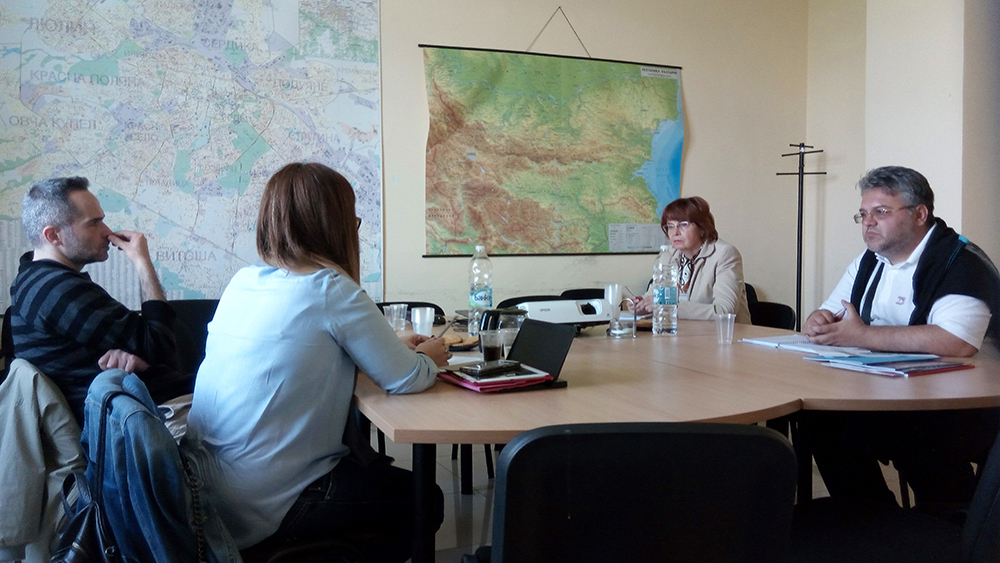
The first day of the visit, the delegation had an interesting exchange with Dr Vyara Georgieva, the Chief Expert in the Ministry of Health for the programmes financed by the Global Fund to fight AIDS, Tuberculosis and Malaria and Petar Tsintsarski, Consultant for the program Prevention and Control of HIV/AIDS. The key learning points from this meeting are that the HIV/AIDS problem should be seen from various angles besides medical: cultural, social etc. and that financing services should be concentrated on the level of local communities.

During the meeting in the National Centre for Addiction with Momtchil Vassilev, Director of the National Focal Point on Drugs and Drug Addictions and Nikolay Butorin, Expert on Training Programmes, the delegation got a lot of data about drugs in the country. Improvement of Early Warning System for new psychoactive substances was an issue of joint interest.

Meeting in the National Centre for Addiction

For the second day of the visit, meetings were first scheduled with two civil society organisations: Initiative for Health Foundation and Centre for humane policy. Our colleagues gave us a realistic and open vies on the situation in the country, especially in the light of termination of the Global Fund support that will cause closing of services to drug users.

Dr Tsvetelina Raicheva, who recently directed the National Addiction Centre provided more statistics about the situation. At the Centre for the Study of Democracy the representatives of the network had a meeting with Mr. Dimitar Markov (Senior Analyst and Project Director, Law Program) and Mr. Atanas Rusev (Senior Analyst, Security Program). The Security program implements criminology research, actively contributes to the Bulgaria’s policy debate on organized crime and participates in projects on crime and security issues. The issues of inadequate funding and bureaucracy in the field of drugs were highlighted in this meeting as one of the biggest barriers at policy level. Moreover, the need for more action in the issue of immigration and its connection to drug use through several routes has to be identified and addressed.

With our friends from Initiative for Health Foundation and Centre for humane policy