The ChemSex challenge – The 2nd European ChemSex Forum

The 2nd European ChemSex Forum, organised by International HIV Partnerships, held in Berlin from 22nd to 24th of March, called for concrete actions at the local level to provide strategic resources to chemsex responders. The aim of the Forum was to develop a platform to engage in international, cross-sector, multi-disciplinary dialogue around ChemSex-defined by the use of specific drugs (“Chems”) in a sexual context – and facilitate coordinated responses to chemsex issues in locales where chemsex related harm is a problem, regardless of its size and impact.

The ChemSex definition, Training day

Clear guiding principles for the 2nd Forum were that focus was on problematic chemsex, not drug use and sex per se. Problematic chemsex is defined, as such, by the individual in interaction with his peers and care providers. Conference planners recognized that various harms related to chemsex are occurring, including HIV, hepatitis and co-infections, STIs, drug overdoses, depressions, rapes and deaths and that our work should be to address those harms forthrightly, not make generalisations about drug use or sexual behavior.  Forum programme focused on 3 key work areas: therapeutic responses, team building and information gathering.

The Forum offered a platform where different stakeholders, professional and individuals could have exchanged experiences and practices in order to better address the issues coming with this new emerging phenomenon. It took place over three days. The first day was the training day on drugs and sexual experiences, risk assessment, models of behavioral change and introduction to motivational counseling, emphasizing the importance of multi-sectoral approach, community engagement and cultural competency. The following days were data and evidence day and community mobilization day that featured the latest data on ChemSex and workshops on multidisciplinary team building and information gathering.

Poster presentation, “Self Reported snapshot Survey” by GWIELINGA@COC.NL

For South East Europe, ChemSex is quite a new phenomenon in comparison to other European regions. Drug Policy Network South East Europe was represented by Irena Molnar and two member organizations HOPS and Positive voice also had their representatives. It created a space for our dialogue to widen up with this interesting and challenging topic, where not only drugs use but also sexuality and gender are important.

Antonios Poulios, PhD(c) MSc Clinical Psychologist and psychoanalyst, also the Scientific coordinator of Red Umbrella Athens and Chemsex Project of Positive Voice Greece, for DPNSEE website said that “The 2nd European ChemSex Forum was a great opportunity to get informed, discuss and meet people from all over Europe concerning ChemSex, get to know current data as well as current interventions. The training was also very helpful giving the opportunity to exchange experiences and learn from others’ expertise”. He also stated that one of the most important conclusions was the emphasis on the affective aspects of the services as well as the balance between the professional and activist point of view.

“In Greece, Chemsex is becoming gradually more common. It is already an issue in the MSMgbtq community as far as problematic use is concerned. However, there are yet quite sparse data. Positive Voice and Athens Checkpoint, in collaboration with the National Kapodistrian University of Athens (2 pathology clinics of university hospitals and the department of psychology), is conducting a project which includes research (both quantitative and qualitative) in order to assess the epidemiology of the phenomenon and the needs of the population. Additionally, focus groups are run and T-groups, self-help groups as well as personal counseling sessions are programmed to be held,” he continued.

His observations regarding ChemSex in the region of South East Europe are in favor of starting the discussion as he claims“it is a not so rare practice however not talked about, and discourse can always ameliorate the problems of action, as psychoanalysis taught us. Given the fact that most countries of SEE face a severe socio-economic crisis, which differentiates the social bond and thus the way subject is related to pleasure and enjoyment, the practice of chemsex is quite representative of this differentiation of the way the contemporary subject is placed within the social bond.”


Ivica Cekovski, advocacy associate from our member organization Healthy Options Project Skopje mentions that “The 2nd European ChemSex Forum, was a tremendous learning opportunity about the successes and challenges of the response to problematic chemsex. It was, in my experience, one of the most interesting and resourceful events that offered crucial information about information gaps, as well as the health, social and legal dimensions around this rising phenomenon.”

For the situation in Macedonia and SEE, Ivica says that is apparent that the region is lacking behind in their response to chemsex. “We have very few, if any, information about the frequency of drug use in sexual context, let alone proper interventions to support people in need. This is despite the fact that anecdotal evidence suggests that the situation might not differ a lot from other European countries.It is, therefore, urgent that we start talking about chemsex in SEE and commence with an assessment of the needs which will help us design and conduct suitable and well-targeted programmes for the wellbeing of key populations.” Ivica said.

Developing a multi-country application for the Global Fund

The South East Europe Regional Coordinating Mechanism (RCM) held the third meeting on 27 February 2018 in Skopje, Macedonia. The aim of the meeting was to agree on elements of the project for the Global Fund’s Multi-country Grant Request for Proposals – HIV: Sustainability of Services for Key Populations in Eastern Europe and Central Asia Region.

The eight countries of South East Europe that are transitioning from Global Fund support to national sources of financing services (Albania, Bosnia and Herzegovina, Bulgaria, Kosovo, Macedonia, Montenegro, Romania and Serbia) welcome Moldova to the RCM.

Participants of the meeting were welcomed by Dr Venko Filipče, Macedonian Minister of Health and Aida Kurtović, Chairperson of the Global Fund Board.

To ensure meaningful consultations within key population, community organizations representatives coming from the key population which RCM would like to cover in the application were invited to a consultative meeting a day before the RCM meeting. Asocijacija Duga from Serbia (working with MSM and Roma community), LGBT Youth Organization DEYSTVIE from Bulgaria (MSM community organization, STAR-STAR from Macedonia (sex workers community) and Asocijacija Doverba from Macedonia (community based organizations of people using drugs) joined the meeting. Two regional networks DPNSEE and ERA participated to. Representatives of our member organisations Margina, Cazas, Juventas and HOPS were among participants.

Specific Objectives of this meeting included:
1. Identify key regional advocacy priorities for 2018 for increasing domestic funds towards sustainability of HIV and tuberculosis programs.
2. Review resource availability and needs, including possibilities for donor-funded initiatives.
3. Map out a regional advocacy plan, for further finalization and adoption by the RCM.

RCM opened discussion if community organisations and networks would take over some of the activities of the project proposed to the Global Fund.

Regional training on budget advocacy and monitoring

Why is it necessary to advocate for adequate funding of drug use harm reduction programs?
Which changes do we expect to achieve by advocating for adequate funding?

The regional training on budget advocacy and monitoring, held from 21 to 23 December 2017 in the hotel Romantik in Veles, Macedonia, tried to provide answers to these and many other questions. The training was organized by HOPS – Healthy Options, Skopje, with the support of the Foundation Open Society – Macedonia and conducted by experts from The Association for Emancipation, Solidarity and Equality of Women – ESE from Skopje.

The participants of the training gained knowledge that will help in their efforts to obtain financial resources from the state authorities, and covered topics that point out the problems that the organizations are experiencing due to insufficient funds, as well as the activities that the organizations can take to solve them. In addition, the process of budget analysis as a basis for advocating for creation of an effective budget as well as the procedures that are important in the process of monitoring and analysis of budgets were analysed.

11 participants come from six harm reduction civil society organisations from the region who are faced with a lack of funding for their programs after the departure of the Global Fund: Prevent and DPNEE from Serbia, Margina and PROI from Bosnia and Herzegovina, and Juventas and Cazas from Montenegro (all members of DPNSEE), and two came from local organisation Becej Youth Association from Bečej, Serbia and Group for Public Policies from Belgrade.

Social inclusion of most at-risk youth in the Western Balkans Region

The EU funded project ARYSE (At-Risk Youth Social Empowerment), implemented in 6 Western Balkans countries aims to contribute to achievement of social inclusion of most At-Risk Youth at the regional level, by strengthening CSOs capacities, regional/national cooperation and advocacy actions. The specific objective of the action is to support equal access to education, employment, justice and other related fields to most At-Risk Youth in the Balkan countries, by fostering the level of active participation and inclusion of CSOs representing young people in decision making and reform processes.

The project partners are ARSIS (Albania), Association Margina (Bosnia and Herzegovina), HOPS (Macedonia), Juventas (Montenegro), NGO Labyrinth (Kosovo), Prevent (Serbia) and SHL Foundation from Germany that has a role of consultant.

Topics that the project addresses include

    • Youth from families with history of drug use and/or conflict with law
    • Street youth
    • Youth who use drugs
    • Youth in conflict with law
    • Youth without parental care
    • Young Roma

    The training mainly organised to provide material for future procedures and guidelines is being held in Skopje, Macedonia, from 15 to 18 October 2017. Experts – Nevena Nikolić, Vlatko Dekov, Dardan Berisha, Jarmila Bujak Stanko, Violeta Kola, dr Meliha Bijedić, dr Anita Burgund and Katarina Mitić – prepared draft standards for specific topics of the project.


    More about the project is available at the website HERE>>>

Drug problem and its influence on children and youth

Representatives of the Drug Policy Network South East Europe, including Nebojša Đurasović, member of the DPNSEE Board, Irena Molnar, DPNSEE Communication officer and office manager and Milutin Milošević, Executive director, met with Ms Vesna Dejanović, Project Officer Child Protection at the UNICEF Belgrade Office. The meeting was held on 11 August 2017.

The motive for the meeting was decision of the Novi Sad authorities to supply free drug tests to parents in local schools (last two classes of elementary and all secondary schools) as from the start of the new school year. DPNSEE sent a letter to the UNICEF Representative in the Republic of Serbia stating that we find this action is jeopardizing children rights and very problematic for several reasons, including:

  • Drug testing in schools is not needed and effective; even it is forbidden in some EU countries.
    Whatever the results of the test should be, confirmed drug use or parents’ mistaken assumptions, the trust between children and parents will be broken.
  • The test are already available in pharmacies. This action can only raise paranoia among parents and have unanticipated and unintended effects.
  • The tests can recognise only “traditional” psychoactive substances – and for each of them a separate test is needed. For a full evidence of drug use, a complete set of several tests is needed!
  • The tests are not functioning with the new psychoactive substances which are even more dangerous than the traditional ones. Young people will simply start using new substances, which may cause more harm than what we have today.

DPNSEE thinks that the society need to invest more into serious and comprehensive prevention, adjusted to current situation, not to repressive measures. That has to be part of a systematic approach to the problem of drug use, especially for children and young people, ranging from school based programs to community interventions.

We informed Ms Dejanović that we shall certainly make an action to oppose this proposal of the local authorities in Novi Sad, which will probably include communication with responsible national institutions (ministries of education, youth and health, Office for combating drugs, etc.).

Another topic for discussion was legislation in the area of social care, where more attention should be given to drug users, especially those who come out of medical treatment or penalty. We agreed to share information about drafts of laws, where DPNSEE shall send our proposals related to the changes of the Law on psychoactive controlled substances.

DPNSEE presented activities on treatment and care of children who use drugs and actions taken by the member organisation HOPS.

Strong “Support. Don’t Punish” campaign in Macedonia

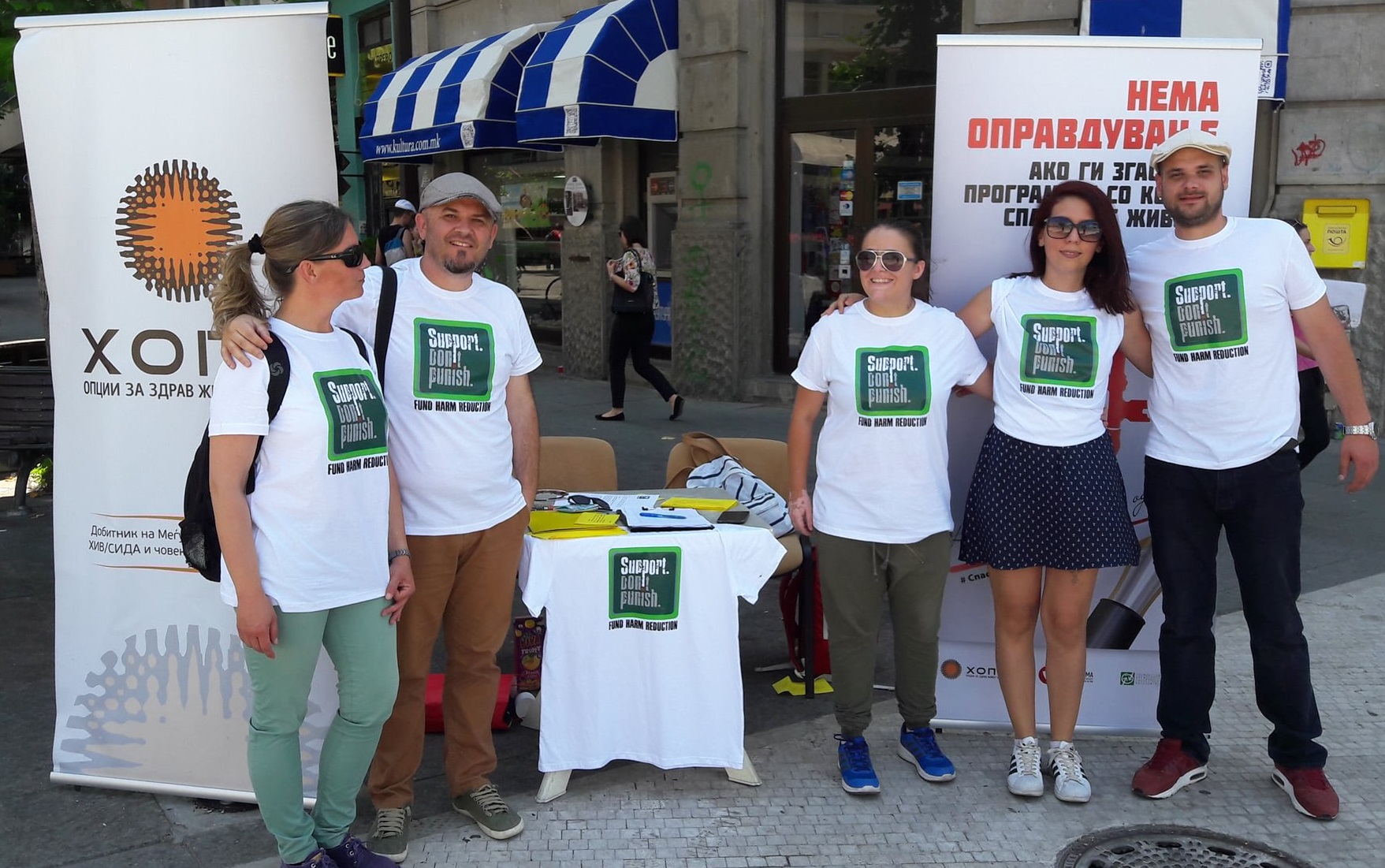
In the period from June 22 to July 07, as part of the “Support Don’t Punish” campaign, Healthy Options Project Skopje – HOPS has implemented activities in Macedonia.

Along with the Sustainability Platform for HIV Awareness Programs, on 22 June 2017, HOPS held a press conference for the need of providing financial resources and continuation of HIV prevention and harm reduction programs in the Republic of Macedonia. Dr. Arben Tarawari, new Minister of Health, also attended to the press conference and stated that the Ministry will support the programs.

The press conference with Dr. Arben Tarawari, Minister of Health

On June 16th 2017, a public call for the best journalistic article was published on the topic: „Sustainability and the need of harm reduction programs in the Republic of Macedonia”. Up to the deadline, 6 articles of journalism (5 texts and 1 video) were reported to the call. The articles evaluation committee has selected the two best articles, followed by a 300$ prize for the first place, and 200$ for second place. The winners are publicly announced on the HOPS website.

Logo of the campaign

With „Save Lives“ logo, an online petition was published to support harm reduction and HIV prevention programs in Republic of Macedonia. So far, 659 persons have signed the on-line petition. Additionally, on June 27th 2017, a stand for collecting signatures for support a petition was set on the city square in Skopje. In total, 980 signatures are collected. The petition will be submitted to the Ministry of Health and the Government of the Republic of Macedonia.

A petition for supporting Harm Reduction Programs and HIV prevention in Republic of Macedonia

Further survival of harm reduction programs and HIV prevention in the Republic of Macedonia is uncertain. The current financial support from the Global Fund to fight AIDS, Tuberculosis and Malaria ends in June 2017. This will result with leaving over 10,000 people who use drugs as well as their family members without proper social and health care.

Thanks to harm reduction programs, only two new HIV cases have been recorded in Macedonia in the last ten years as a result of drugs injecting and less than 5% of 315 registered cases of HIV were people who inject drugs. These figures are far smaller than in the neighbouring countries. Macedonia can boast with the lowest HIV rate in Southeast Europe, but if these programs are not implemented, there is a risk of HIV epidemics as a result of interaction with the epidemics in neighbouring countries and the possibility of increasing risk behaviours.

There are 17 harm reduction programs in Macedonia (4 in Skopje and 13 in different other cities). These programs are efficient and financially worthwhile. According to the research analyses, the cost for one client in harm reduction programs is approximately 155 € per year. In contrast, the cost only for medicines for a patient with hepatitis C is up to 13.194 €, and the untimely and inappropriate treatment of hepatitis C causes cirrhosis and liver cancer, whose treatment costs more than 30.000 € per patient. Additionally, the costs of treating HIV and hepatitis C financially exhaust the families of people in need of treatment, thereby further multiplying undesirable costs and disrupting overall social well-being.

Therefore, a petition was initiated to request the Ministry of Health and the Government of the Republic of Macedonia to:

  • Adopt an urgent solution for using funds from the HIV program and the remaining funds from the Global Fund for key programs across the country, which will ensure continued assistance to citizens and the prevention of HIV.
  • Establish cooperation between the Ministry of Health and the civil society and other stakeholders for adoption of appropriate laws or by-laws and measures that will guarantee transparency, adequate expertise and long-term sustainability and development of HIV prevention programs.

Sign up the petition here!

Healthy Options Project Skopje produced advocacy movie in cooperation with Drugreporter to support the campaign and save underfunded harm reduction programmes which are a huge success in the region. Watch the video produced and learn more!

Support. Don’t Punish – SEE Country activities

Albania

In the frame of the 26th of June and the world campaign Support. Don’t Punish, Aksion Plus will organize awareness activities in two cities, Tirana and Durrës, distributing leaflets and sharing information especially to young people. In parallel, they launched an online blog inviting young people, their beneficiaries and partners such as Y-peer, YMCA, Youth Voice network to write “What would you do about drug user’s rights, if you were a Prime minister” related to the drug policy reforms, treatment, and other related actions.

Other activities also involve their clients at opioid substitution therapy centres (OST) where they organise small group discussions, outreach information, leaflets distribution, one to one conversations and counselling to raise their awareness on how to better protect their rights, as well as to provide referrals to other institutions in case they face violations from police, courts and law enforcement agencies. The most vulnerable groups among their clients (i.e. street users, sex workers who use drugs, LGBT members) are strongly encouraged and supported to fight for their rights and report to Aksion Plus or to People’s Advocate when they face violence or marked stigma. Their six OST centres will be very active to convey the message of this campaign. Aksion Plus will also try to extend the activities with decision makers and politicians though it will be difficult as the general elections will take place on 25 of June. They have presented their ideas on drug policy and interventions during the Democratic Party election campaign.

Contact: gencaxionp@albmail.com


Bosnia and Herzegovina

To mark the day of 26th of June Association Margina planned a series of activities:
1. Public debate “Addiction and drug addicts in the legislation in Bosnia and Herzegovina”
The public debate on this subject will be held on 26 June, in cooperation and partnership with the University of Tuzla. Professors and students of several universities (Law, Medicine, Education and Rehabilitation, Philosophy and Pharmaceutical) will participate. The goal is that academia provides guidelines on the suggestions of experts and NGOs that Bosnia and Herzegovina need Lex specialis “Law on Drugs” that would encompass all aspects of this phenomenon and its application in the society like the one in Bosnia and Herzegovina.

2. Marking the global campaign “Support. Don’t Punish”
The evening of 26 of June will be dedicated to outdoor activities and promotion campaign supported by local DJs and socially engaged bands. During activities, a documentary film “I want to wake up,” will be shown, which gives a complete picture of the life of five drug users in different stages of their life.

3. Press conference and promotion of strategic documents
This event will be the introductory full-day program aimed to the media and partners that want information about these important documents and the developments regarding the Global Campaign to reach to the largest possible number of citizens of Bosnia and Herzegovina. At this event Margina will promote the following documents:
• National Strategy of Bosnia and Herzegovina on Drugs 2017-2022
• The policy for reducing harm from drug use in the Federation of Bosnia Herzegovina
• EU Action Plan 2017-2020

Contact: berinabahic@gmail.com


Greece

A group of civil society organisations from Greece will participate in the campaign:
• “CENTRE FOR LIFE” – for the support of people living with HIV/AIDS
• “DIOGENIS”- Drug Policy Dialogue
• “PeNUPS”- Peers’ Network of Users of Psychoactive Substances
• “POSITIVE VOICE”- Association of People living with HIV/AIDS
• “PROMETHEUS” -Hellenic Liver Patient Association
• “PRAKSIS”

These organizations constitute the “Greek Platform for Psychoactive Substances”, an unofficial initiative for joint action among organizations working in the area of drug policy and psychoactive substances. This year all these organizations are supporting the campaign and are responsible for its implementation in Athens, Greece. You can find more at https://www.facebook.com/supportdontpunishGreece/

Activities in Greece will include:
1. Press conference by “PeNUPS” supported by all the aforementioned organizations on 27 June from 12:00 to 14:00 at  Romantso, 3-5 Anaksagora Street, Omonia, Athens with aim to promote the campaign, highlight the actual needs of people who use drugs by giving floor directly to people who are the most affected by problematic drug policies. The challenges in the national drug policy will also be presented and the need for drug law reform and peer involvement will be promoted as one of the basic principles of harm reduction. The discussion will be coordinated by the journalist Mrs. Sotirchou Ioanna.
Facebook event: https://www.facebook.com/events/203865003471040/

2. Street event (all the aforementioned organizations) with aim to make the campaign more visible to the general population and to offer some services to people who use drugs (e.g. food, mobile washing machine service, shower bus, rapid tests for HIV/HBV, HCV) Date: to be announced Location: SIN Athina, Athens at 19.00 pm, at Varvakeios square
Facebook event:https://www.facebook.com/events/321069778316468 

Contact: sofia.galinaki@diogenis.info


Macedonia

HOPS – Healthy Options Project Skopje opened the newspaper articles contest on the topic: „Why harm reduction programs are needed in the Republic of Macedonia“. You can find the call for articles here http://hops.org.mk/mk/content/povik-za-izbor-na-najdobra-novinarska-statija-na-tema-odrzhlivosta-i-potrebata-na-programite.

Subsequently, organization announced on-line petition for support on harm reduction programs in the Republic of Macedonia. You can find it at following link: https://www.change.org/p/ministry-of-health-and-the-government-of-the-republic-of-macedonia-a-petition-for-supporting-harm-reduction-programs-and-hiv-prevention-in-of-macedonia

On 25 and 26 June, HOPS will collect signatures for the petition in the main square in the city of Skopje while on 30 June they plan to submit the petition to the Government of the Republic of Macedonia and announce the winner article.

Contact: vlatkod@hops.org.mk


Montenegro

Our Member organization Juventas with other civil society organisations and community-based organisations, including youth organisations organises campaign in capitol Podgorica, but with national coverage on several activities. One of them is media launch of the questionnaire for young people living in Montenegro. NGO Juventas and the Montenegrin Union of high school students as a main aim of the survey will try to obtain information from young people about young people. They will be used to continue creating activities aimed at young people in Montenegro, in the area of drug use. The questionnaire is completely anonymous. Survey among Youth on drug use you is available here https://www.surveymonkey.com/r/Juventas

In 2017, the campaign is planned to cover 3 topics: 1) Harm Reduction, 2) Non-existing treatment for underage people who use drugs, 3) Young people and drug use.  Special attention will be given to topic of young people and drug use, which will be a part of youth debate that we will organize around Action Day.

Facebook event: https://www.facebook.com/events/799566700220674/ 

Contact: tijanap@gmail.com


Serbia

Belgrade

Within the “Support. Don’t Punish” Global Day of Action NGO Re Generation is planning to organize a movie screening night that will aim to address the main obstacles and main problems regarding current drug policies in Serbia and wider. The event will be organised in Kvaka 22, on the 26 June, and the details of the event you can find on the Facebook event https://www.facebook.com/events/312618992520893

The three movies that will be screened will represent different sides of public health and human right issues related to drug use, including three different aspects of use such as recreational, problematic and medical and obstacles that exist when accessing information, services and other relevant programs.
Movies to be screened are:

  1. “Clubbing and youth health” – Harm reduction programs in recreational setting
  2. “Medical cannabis legalisation in Serbia” – Medical cannabis is legal in places as diverse as Canada, Uruguay, Israel and Jamaica. How would legalisation of medical cannabis look in Serbia?
  3. “Without shift” – What happened to NSP programs in Serbia after the Global Fund discontinued funding in Serbia.

Participant of the debate are:
Galeb Nikačević – VICE Srbija
Bojan Arsenijević – Re Generation
Teodora Jovanović – KSEA,
Ognjen Martinović – Re Generation

Contact: ngo.re.generation@gmail.com

Novi Sad

The Association Prevent will organise street action on 26 June from 10AM to 13AM in front of „Slobodan Bajić“ student home. The public event will include wearing t-shirts with „Support. Don`t Punish“ message and photograšhing people in the street who will be holding boards with the same slogan. Free t-shirts will be given away to people who want to support the campaign.

Contact: djnebojsa84@yahoo.com


Romania

RHRN with their partners will have the street activity around 2-3 open-air tents that will be installed in the centre of Bucharest, close to the University, to distribute information, the comic book on drugs, some banners on legalization and the campaign, presentations of the NGOs activities and distribution of some drug testing kits (LSD, ecstasy).

Contact: drosca@rhrn.ro

Annual Drug Policy Conference

The Annual Regional Conference in South East Europe was organised in Thessaloniki from 8 to 10 June 2017. The conference aimed to bring together NGOs, policy makers and researchers active in the drugs field in the region of South East Europe, in order to discuss drug policy developments and trends, exchange experiences and best practices in the region, Europe and the United Nations.

The conference is part of the regional project “Strengthening NGO capacity and promoting public health and human rights oriented drug policy in South East Europe”, supported financially by the European Commission and the Open Society Foundations. The organiser was Diogenis, Drug Policy Dialogue.

National drug coordinators from Romania and Croatia

The Conference agenda included a large number of interesting issues:

  • The Sustainable Development Goals 2030 and drug policy. Priority issues, the role of UN agencies, expected commitments from the member states and role of NGOs. Presenter was Jo Dedeyne-Amann, Chief Secretariat to the Governing Bodies, Division for Treaty Affairs, UNODC. Nikos Stergiou, Communication and public relations Officer, Diogenis, presented experience of two local meetings.
  • Initiatives undertaken in the countries of our region related to implementation of the outcomes of the UNGASS and the role of NGOs. National drug coordinators presented work in their countries: drug co-ordinators: Sorin Oprea (Romania), Milan Pekić (Serbia), Željko Petković (Croatia) and Manina Terzidou, head of the Greek Monitoring Centre for Drugs (EKTEPN) (Greece)
  • Women and Drugs. Facts and Special Characteristics for Girls and Women who use drugs was the presentation from Meni Malliori, Professor of Psychiatry at the University of Athens, while Georgia Aslanidou, Psychologist, OKANA Thessaloniki presented about Addicted mothers and the journey of therapy
  • Drugs and internet: experiences, opportunities and concerns in the use of online counselling tools presented by Ilias Paraskevopoulos, Consultant for addictions at KETHEA ITHAKI
  • The Harm reduction project in South East Europe. Developments and next steps presented by Sofia Galinaki, Advocacy Officer, Diogenis and Peers’ involvement in harm reduction, with introduction from Christos Anastasiou, Peer Network of Users of Psychoactive Substances (PENUPS).
  • Irena Molnar and Bojan Arsenijević from the NGO Re Generation, Serbia provided valuable insight into Changing culture in drug use including new psychoactive substances
  • Developments in the discussion about cannabis policy in countries of SEE
Irena Molnar presenting about Changing culture in drug use including new psychoactive substances

Representatives from 14 DPNSEE member organisations, 3 Board members and all 5 Staff were at the Conference. We presented the Network, strategic priorities and plans for the future. Our two volunteers talked about their work on the Glossary and Resource Pool.

Marios Atzemis, DPNSEE Board member, making an intervention

The Conference was a very good opportunity to share and learn about interesting ideas and make plans for the future.

YODA Workshop for young activists in Europe

Last week (15 – 22 May) around 30 young people from 12 countries gathered in Belgrade for another round of workshops organised by Youth Organisations For Drug Action in Europe. This time the workshops, funded by European Youth Foundation and Open Society Initiatives, focused on “Promotion of social inclusion and protection of human rights among young drug users “.  Young people came from Serbia, UK, Belgium, Slovakia, Poland, Romania, Bosnia, Montenegro, Albania, Hungary, Bulgaria and Macedonia and representative of the Council of Europe. 5 of them were representatives of DPNSEE member organisations Juventas, Re-Generation, Aksion Plus, HOPS and Margina.

The aim of the workshop was to analyse different aspects of human rights violations regarding young people and drugs through mentioned topics, so that official document can be drafted, addressing policy change in order to overcome different problems and prevent human rights violation in the future. Within 7-day long workshop participants were showcasing examples of human rights violations of young people protected under the European Convention on Human Rights and also compared the criminal penalties for drug offences in their countries, compared cases of young people receiving drug treatment and discussed access to drug treatment for young people who use drugs.